
When Skydiving, is the Feeling of Weightlessness Caused by an Equilibrium Between the Downward Force of Gravity and the Upward Buoyant Force of Air Causing Drag on Your Body?

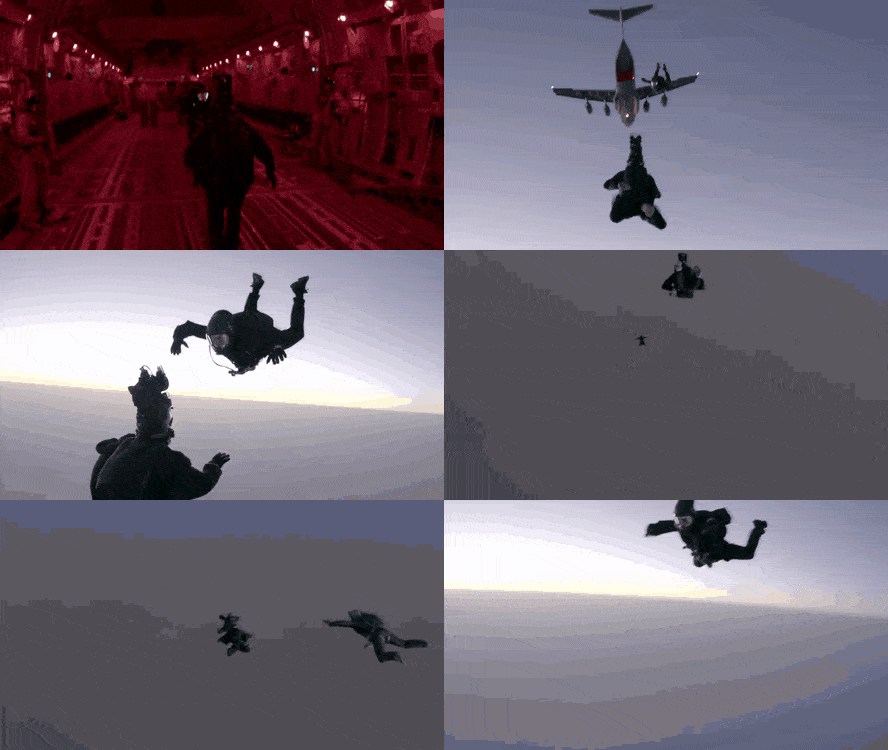
The Short Answer Is: No
The Long Answer Is:
When skydiving, very quickly you reach “Terminal Velocity”, which means that your weight is equal to the drag on your body from the upward buoyant force of air. However, the key to understanding weightlessness is to realize that it a matter of pressure differential, not Gravity. It has to do with the summation of various force vectors acting upon you that results in a compression feeling, which you experience as weight or weightlessness, whatever the case may be.
Terminal Velocity is the maximum speed attainable by an object as it falls through a fluid (air is the most common example). It is reached when the sum of the drag force, which is created by our body’s mass, and the upward buoyant force, which is the atmospheric pressure all around you, is equal to the “downward force”, which is not actually a real downward force, but rather, it is the consequence that all objects find their natural place in the atmospheric density around them, depending upon the objects density, as the result of Natural Law, not Gravitational pull. You are denser than air, and so, your body will seek to find its natural place in the atmospheric density surrounding it and will descend until it does. It will descend until it reaches a medium that is denser than your body…hopefully not the concrete below at terminal velocity!
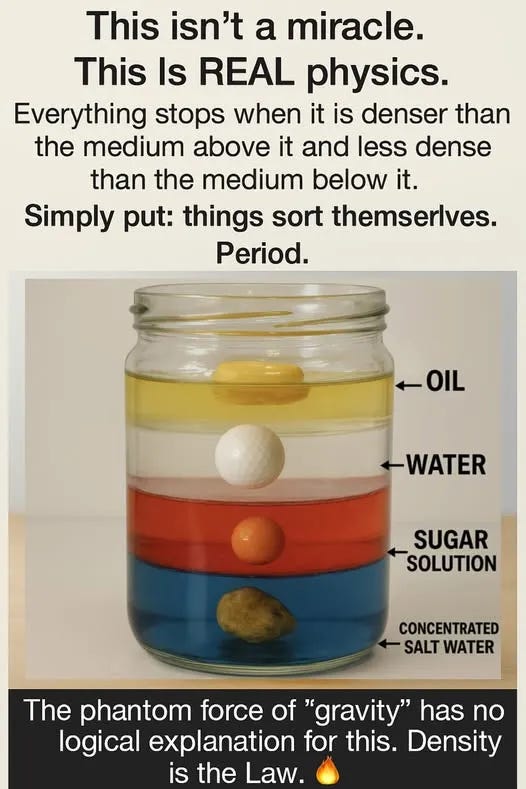
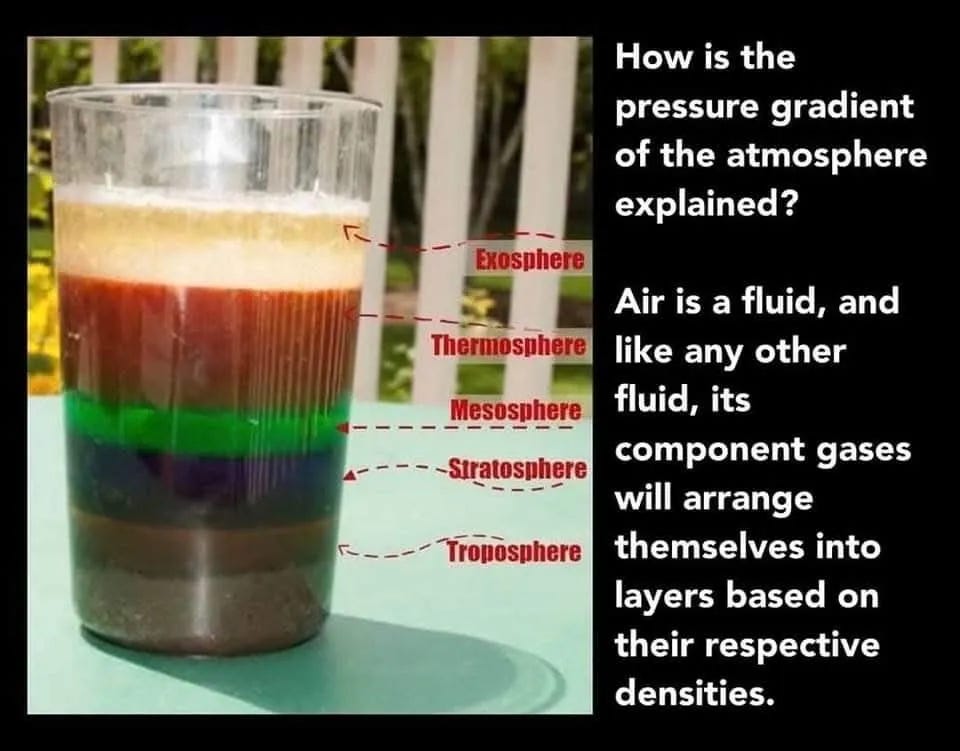
This has do with The Natural Order of things. The Natural Order of things involves equilibrium. Every object falls until it finds a medium denser than itself. This is simply the way in which Nature was designed, no further explanation is required, and Gravity certainly is not needed for this natural condition. For example, no gravitational downward vector is required for water to fall beneath oil. Water falls beneath oil because it is less dense and immiscible with water. Oil molecules are not attracted to water molecules, and since oil is lighter, it will form a separate layer on the surface. It has to do with the way more dense and less dense objects and mediums naturally distribute themselves to find their place in any given surrounding atmospheric pressure density.
Back to Skydiving:
Nevertheless, there is no gravitational attraction from The Earth pulling you down during skydiving. You are simply descending because The Natural Order of objects in motion dictates that denser objects fall and lighter objects rise, when integrated into a given atmospheric density. Try “skydiving” in a swimming pool, and everything changes. Suddenly, the upward buoyant force of water is so strong that you tend to float instead of falling, for the most part. In other words, the “drag force”, which is the resistive force that opposes the motion of an object through a fluid like air or water, which is created by the upward buoyant force of water on your body is so great that it prevents you from free falling.
What Causes The Feeling of Weightlessness That You Feel When Skydiving?
The feeling of weightlessness that you feel when skydiving after having reached terminal velocity (NOTE: The few seconds before reaching terminal velocity you feel like you’re falling.) basically happens when you have no sense of your own weight. It has nothing to do with an equilibrium between the downward force of an imaginary Gravity and the upward buoyant force of air causing drag on your body. It is simply a matter of not being able to feel your own body mass while standing on a medium so dense that your legs must take the pressure of an unyielding upward buoyant force, which is the ground. Meanwhile, you are immersed in an atmospheric pressure on the ground of 14.7 pounds per square inch (psi). On the ground, you are being pressed on all sides by this 14.7 pounds per square inch (psi). You experience this on your body as weight. It is pushing against you, while the ground is also “pushing” up at you, compressing your body in an atmospheric pressure field of 14.7 pounds per square inch (psi). This pressure is caused by the weight of the air pressing down on the Earth’s surface. Remember, the ground is also “pushing” up against the atmosphere. A column of air one inch square, extending all the way up through the atmosphere, weighs about 14.7 pounds.
The summation of all these force vectors results in a compression feeling, which you experience as weight. When you free fall, you no longer have the ground as a solid and unyielding upward buoyant force to act upon you. Subsequently, there is a huge change in the pressure differential. A pressure differential is the difference in pressure between two points, calculated by subtracting one pressure from the other. In other words, “the pressure is off”, and you feel weightless. You need the solid ground in order to feel you own weight because, again, on the ground, you are being pressed on all sides by this 14.7 pounds per square inch (psi), while the ground is also “pushing” up at you. You experience this on your body and muscles as weight. Again, it’s all a matter of the experience of pressure and not Gravity.
Additionally, there is a downward vector “psi on the ground” which depends upon the object, as it’s a measure of weight distributed over the contact area with the ground. For example, an average passenger car exerts about a 30 psi downward vector, while a human male standing exerts around an 8 psi downward vector, and a vehicle with large tracks like a dozer, which has a larger surface area in contact with the ground, can have a much lower downward vector ground pressure (around 5-7 psi). The psi is calculated by dividing an object’s weight by its contact area.
And so, when standing on the ground, you can feel your own weight because your legs are in contact with the ground in a resistance battle with the Earth’s surface to negotiate all of these atmospheric pressure vectors acting upon you. Similarly, when riding an amusement park ride that spins you around, you feel your weight (higher than usual) as you’re plastered against the side of your compartment. On an amusement park ride, a person is pushed inward by the compartment wall, similar to The Earth “pushing” up against you when you are standing. By Newton’s First Law, an object not moving in a straight uniform path must have a net force on it, and in order to move in a circle, that net force must be inward. Once the ride gets up to speed, all the acceleration is radial (inwards). The inward force of the amusement park ride compartment wall against your body is analogous to the ground “pushing” up against your legs when you are standing, You feel this pressure as weight. These weight-sensations originate from contact with supporting floors, seats, beds, bathroom scales, and the like. This sensation of weight is also produced when contact forces act upon and overcome a body’s forward linear inertia by mechanical forces such as in a centrifuge, a rocket taking off, a train going around a turn, or within an accelerating or turning vehicle.
And so, there you have it. The feeling of weightlessness that you feel when skydiving after having reached terminal velocity simply happens when you have no sense of your own weight.
The Natural Order of Matter Requires No Gravity to Explain Directional Vectors

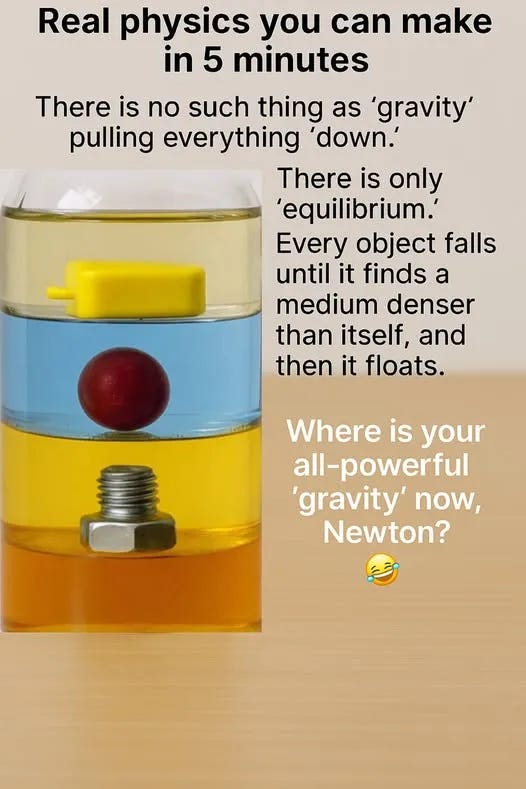
Directional vectors, with respect to falling and rising objects, are not a matter of, “Some force must pull objects down or we cannot understand why things fall.”, but rather, they are a matter of the fact that all objects find their natural place in the atmospheric density around them, depending upon the objects density, as the result of Natural Law, not Gravitational pull. Inserting an extra directional vector into the Natural Order of things in the form of Gravitational pull is both unnecessary and unproven. It is enough to observe that The Natural Order of objects in motion dictates that denser objects fall and lighter objects rise, when integrated into a given atmospheric density.
The Natural Order of things involves equilibrium. Every object falls until it finds a medium denser than itself. This is simply the way in which Nature was designed, no further explanation is required.
Nothing is pulling anything down. Objects simply find their place in The Natural Order. The Universe Doesn’t Pull, It Sorts:
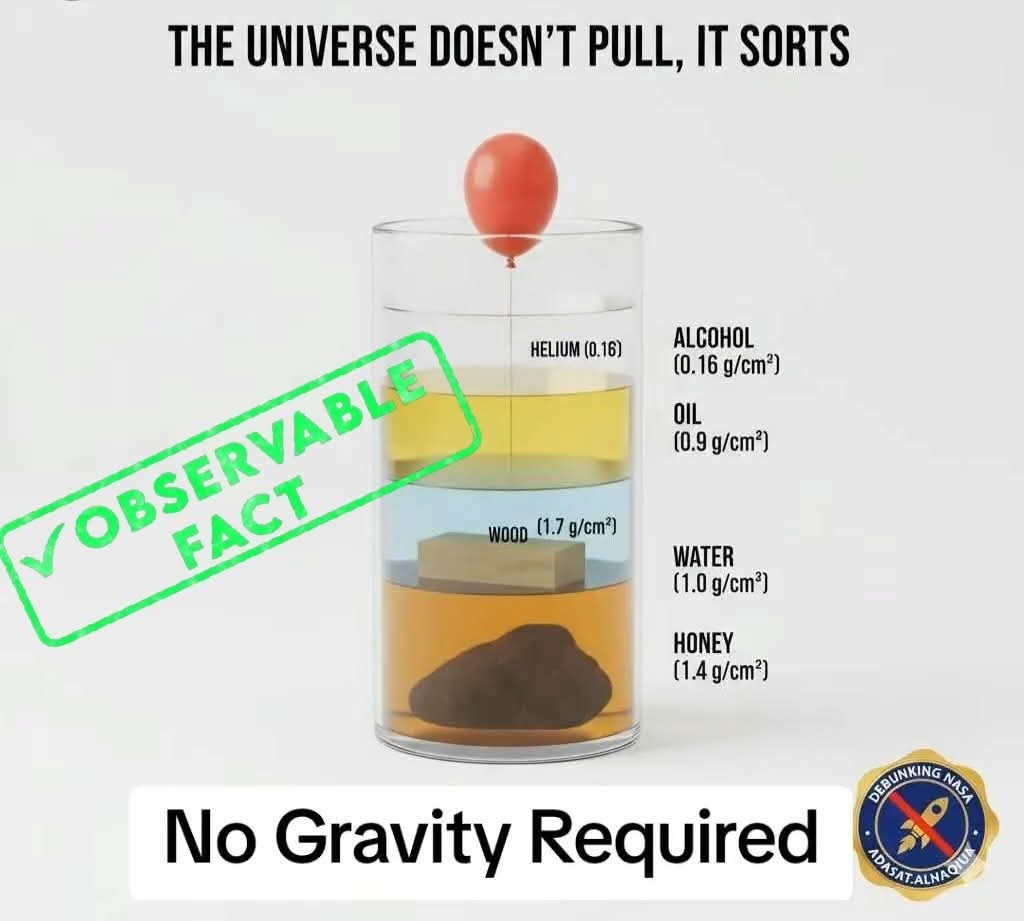
Density and Buoyancy are interconnected concepts related to the behavior of objects in fluids. Density, defined as mass per unit volume, determines whether an object will float or sink in a fluid. Buoyancy, on the other hand, is the upward force exerted by a fluid that opposes the weight of an immersed object.
Additionally, what is very odd and suspiciously revealing is that Heliocentrists will demand endlessly for evidence of a downward force, if not Gravity, to create the downward vector, but you will almost never hear them speak of the necessity of an upward Buoyant Force to explain why things rise. They are fixated upon the Gravitational pull theory so much that they abandon all else on Physics, like the upward Buoyant Force, which is actually acknowledged by academia as a real measurable force. For all intents and purposes and every practical sense, one may as well say that it is the natural inclination for all things to rise from The Buoyant Force unless the presence of The Buoyant Force is absent. It’s really the same as the Heliocentric logic for the necessity of a downward force, just in reverse. It works both ways, and it turns the tables on The Helioelectric downward vector rhetoric, as well as exposing it for the bias that it is.

From here, if one wants to further build a model for the downward vector, one can simply herent Electrostatic Acceleration into the equation because this is based upon provable Physics, not imaginary Gravitational speculations:
But What is Really Behind Downward Acceleration? Incoherent Electrostatic Acceleration Creates The Downward Vector
Weight also plays a critical role in all this:
Weight is not caused by gravitational pull, as modern pseudoscience says. Weight is the difference between the dielectric displacement within a mass and the dielectric displacement outside the mass in the Aetheric wind, creating a downward vector in the direction of the negative polarity, as the Aetheric wind “blows” through a mass. For example, if you increase the volume of water in a ybucket, it will possess more weight as that increase in volume displacement interacts with the surrounding Aetheric field’s dielectric displacement. In other words, weight is a function of the relationship between The Aetheric Field and the electron displacement of an object, combining the effects of both the external electric field and the polarization of the material, with dielectric displacement mediating coherence between these field modalities. Therefore, weight, misnamed “Gravity,” is merely a property of dielectric differentials in The Aether, in conjunction with the “molecular density” and buoyancy conferred to objects by the magnetic and dielectric properties of The Aetheric Field. Objects need not be ferrous nor necessarily “magnetic,” per se, to be effected by The Aetheric field, since it is not the object that is causing repulsion or attraction, but rather, it is the exclusive property of Aetheric Field perturbation that causes any movement of objects, or light, for that matter. Magnetism is not one thing, and the point is that when both magnetic and dielectric properties conjoin to create perturbations in The Aetheric field, we witness movement in matter. The net result is that incoherent electrostatic acceleration helps to create the downward vector.
Weight more specifically is:
· Location Specific
· Medium Specific
· Vector Specific
· Magnitude Specific
· Phase Specific
· Field Coherency Specific
How Incoherent Electrostatic Acceleration Creates The Downward Vector:
Hello Gregory- Could you show us some diagrams or short videos about the movements of the sun and moon in relation to the earth? Your article about the moon confused me big time-because it doesn't explain how the different phases can be observed and look identical from any point on earth. Ditto for the sun. Please show us visually how the seasons work plus of course, sunrise and sunset. Thanks.