The Difference Between the One-Time Christian Resurrection of the Body After Death and the Multiple Recycling of the Body in Hindu Reincarnation after Death

To Begin With:
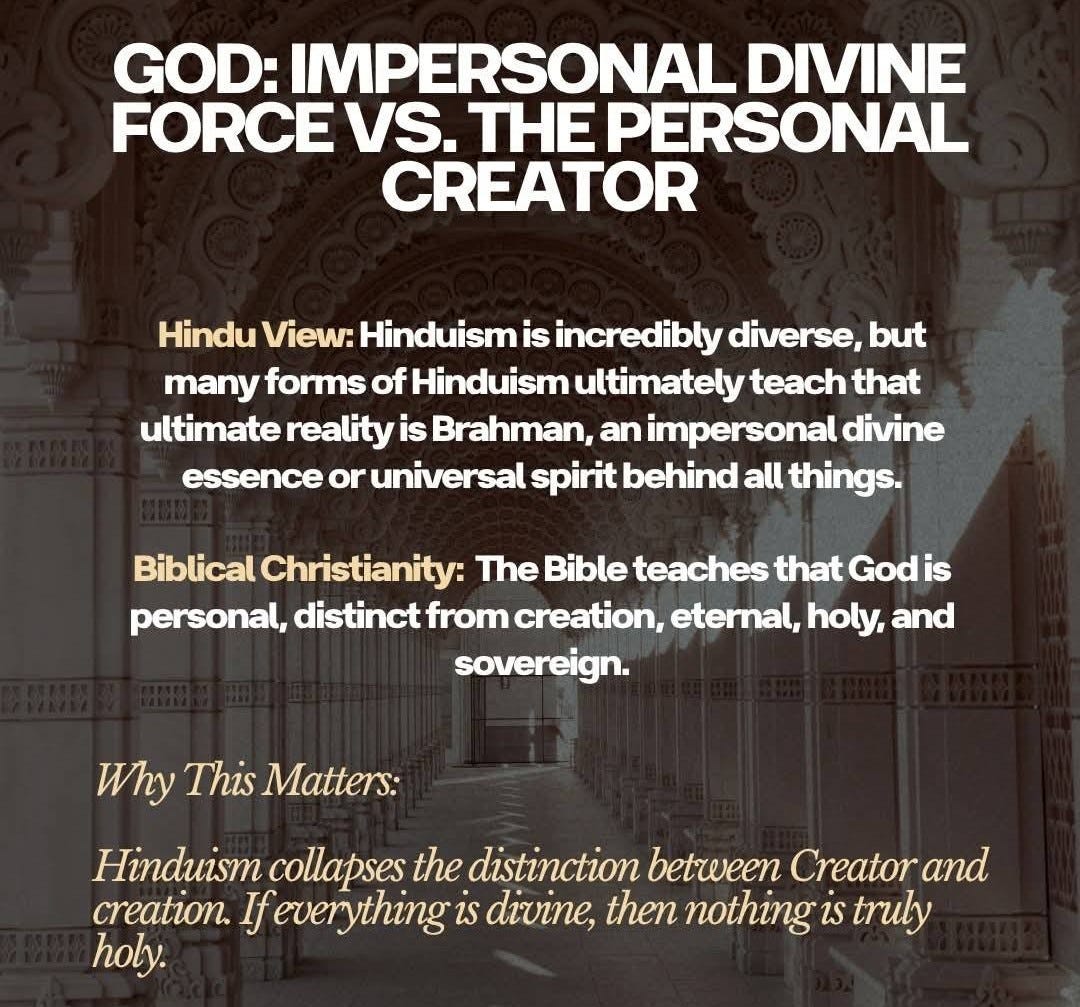
The Christian God is Loving, Personal, and Distinct from Creation:
In Christianity, God is fundamentally a personal being, not an abstract force or energy, but a relational God who possesses intellect, will, emotions, and the capacity for genuine love and communion. This is revealed most clearly in the doctrine of the Trinity: one God in three coequal, co-eternal Persons—Father, Son (Jesus Christ), and Holy Spirit. Each Person relates to the others in perfect love from eternity past, before any creation existed. God is not solitary or impersonal; He is inherently relational.
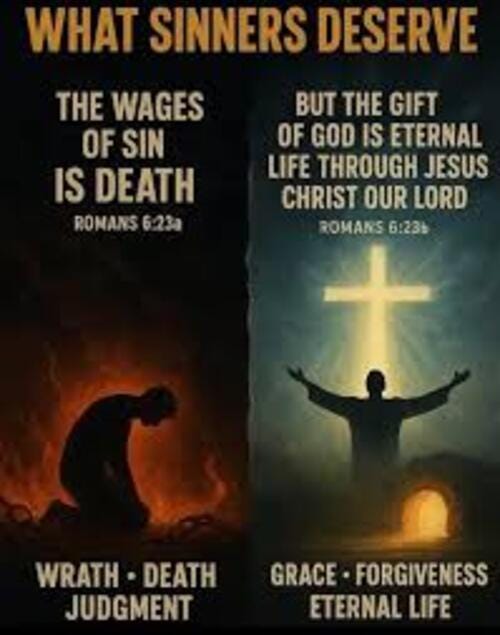
God is loving in His very nature. The Bible repeatedly describes Him as love itself (e.g., “God is love”). This love is not abstract or conditional but active and sacrificial. The supreme demonstration is the incarnation and atoning death of Jesus Christ: God the Son entered human history, lived among people, and willingly died on the cross to bear the penalty for humanity’s sin so that individuals could be forgiven and reconciled to Him. Salvation is a gift of grace received through faith in Christ, not earned through human effort. God initiates a relationship with people, calls them by name, hears prayers, forgives, comforts, guides, and promises eternal fellowship with Him.
Crucially, the Christian God is separate from His creation. He is the transcendent Creator who spoke the universe into existence out of nothing (ex nihilo). The Bible maintains a clear Creator-creature distinction: God is not part of the world, nor is the world an emanation or extension of God. Creation is good but finite and dependent on Him; humans are made in God’s image for a relationship with Him, yet they remain distinct beings. God is “wholly other”—infinite, holy, sovereign—while still immanent, actively sustaining and involved in His creation. There is no merging or absorption into God; eternal life means joyful, personal communion with Him forever, where the redeemed retain their individual identities.
Conversely, the Eastern Mystical Religions Teach That God is an Impersonal Creative Force, Necessitating and Requiring Endless Cycles of Reincarnation and Karmic Struggle:
By contrast, Eastern mystical traditions (such as certain streams of Hinduism, Advaita Vedanta, and related philosophies) generally view ultimate reality—often called Brahman, the Tao, or the Absolute—as an impersonal Creative Force or universal consciousness. This is not a personal deity with will, emotions, or relational capacity, but an all-encompassing, non-dual essence or ground of being from which everything arises. God (or the Divine) is not “someone” but the underlying oneness or energy of existence itself. Distinctions between self and divine, or subject and object, are ultimately illusory (maya).
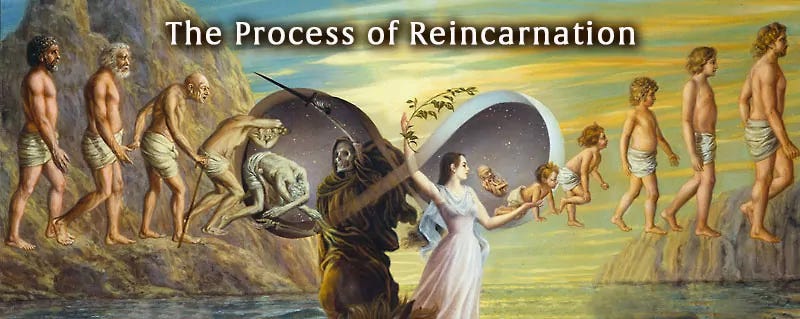
In these systems, individual souls (atman or jiva) are trapped in an endless cycle of reincarnation (samsara), moving through countless lives in various forms. This cycle is driven by karma—the impersonal law of cause and effect, where actions in one life determine the circumstances of the next. One’s “karmic debt” accumulates through ignorance, attachment, and wrongdoing, binding the soul to suffering and rebirth. Liberation (moksha, nirvana, or enlightenment) comes only after this debt is fully paid through rigorous self-effort, discipline, ascetic practices, and enduring the “horrendous struggle” of repeated births, deaths, and sufferings across eons. There is no external savior; the individual must work out their own release through personal striving, meditation, and realization.
Ultimate liberation means merging with or realizing identity with the impersonal Creative Force. The separate self dissolves into the oneness of Brahman or the Absolute, like a drop of water returning to the ocean. There is no eternal personal relationship or retained individuality, only absorption into the undifferentiated divine essence, ending the illusion of separation.
Core Contrast:
Christianity presents a God who is loving and personal, reaching out in grace to redeem distinct individuals for eternal relationship, with a clear separation between Creator and creation. Eastern mystical views portray an impersonal force or oneness that one eventually merges into, after exhausting karmic obligations through self-powered struggle across endless reincarnations. These represent fundamentally different understandings of divinity, humanity, salvation, and the goal of existence.
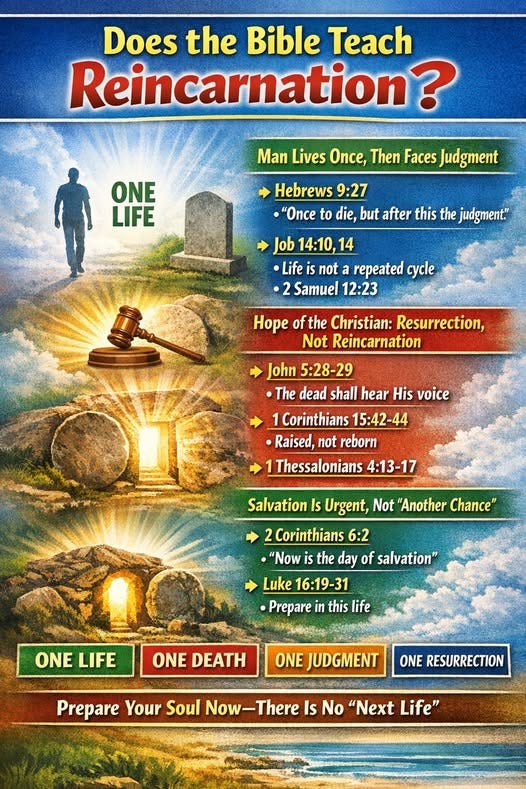
Christian Resurrection of the body refers to a singular, future event tied to the end of history and God’s final judgment:
Core Idea: A human being lives one earthly life. Upon death, the soul separates from the body and goes to an intermediate state (heaven, hell, or purgatory in some traditions). At the end of time (the Parousia or Second Coming of Christ), God raises all the dead in a general resurrection. The same individual body that died is reunited with the soul—but transformed into a glorified, imperishable, spiritual body (see 1 Corinthians 15:35–54).
This is Not Reincarnation. The person does not return to another earthly life to live again in the same way. The resurrection is the definitive, once-for-all restoration of the whole person (body + soul) for eternal life in the renewed creation (the “new heavens and new earth”) or for final condemnation.
Key Scriptural Anchors: Apostles’ Creed (“I believe in… the resurrection of the body”), Nicene Creed, Daniel 12:2, John 5:28–29, Revelation 20–21.
Emphasis is on continuity of identity (the same “you”) and the goodness of the material creation—God redeems the body rather than discarding it permanently.
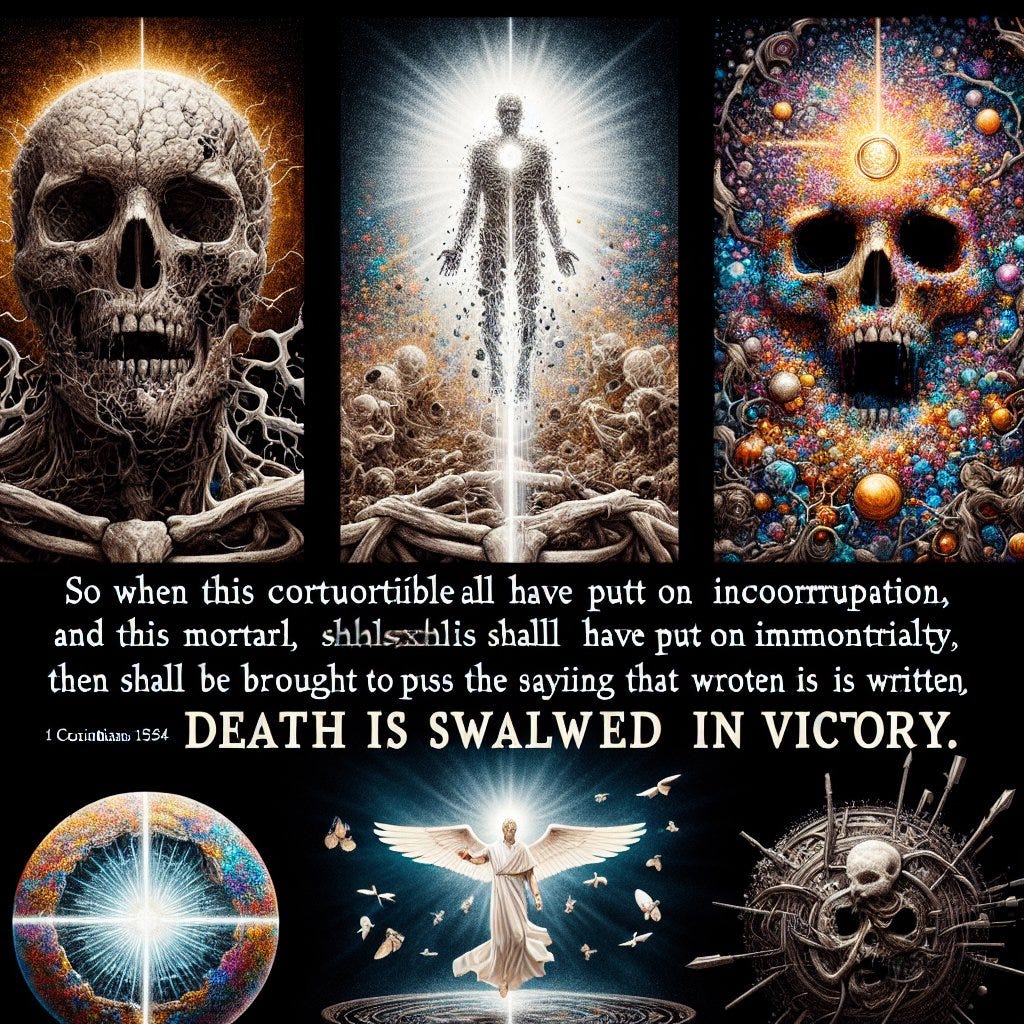
Hindu Reincarnation (Punarjanma / Samsara) refers to a repeated, cyclical process of death and rebirth driven by Karma:
Core Idea: The eternal soul (Atman) is distinct from the temporary physical body. When the body dies, the Atman, clothed in subtle karmic impressions from thoughts, words, and deeds, takes a new body (human, animal, or other forms depending on karma). This cycle of birth-death-rebirth (samsara) continues across countless lifetimes until the soul achieves liberation (moksha).
The Body is Not Resurrected or Redeemed: It is shed like old clothes. A new body is acquired according to the quality of past actions and desires. There is no single “end of history” event that stops this for everyone at once.
Key Concepts: Karma (law of moral causation), samsara (the wheel of rebirth), and moksha (release through knowledge, devotion, or righteous action, depending on the school—Advaita Vedanta, Bhakti traditions, etc.). Texts: Bhagavad Gita (esp. 2:22, 4:5–8), Upanishads.
The Ultimate Goal is to Transcend The Cycle Entirely: The ultimate goal is to transcend the cycle entirely, realizing the Atman’s identity with Brahman (ultimate reality) or reaching a state free from rebirth.
In short, Christian resurrection is a one-time divine restoration of the whole person at history’s end, while Hindu reincarnation is an ongoing recycling of the soul through many bodies until spiritual liberation breaks the wheel. These reflect fundamentally different cosmologies: linear-redemptive versus cyclical-karmic.
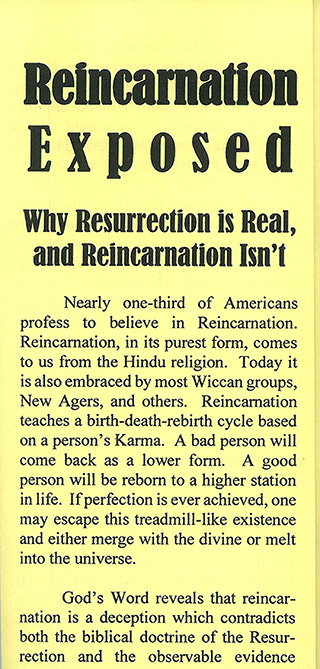
The Ruthless and Endless Cycles of Reincarnation:
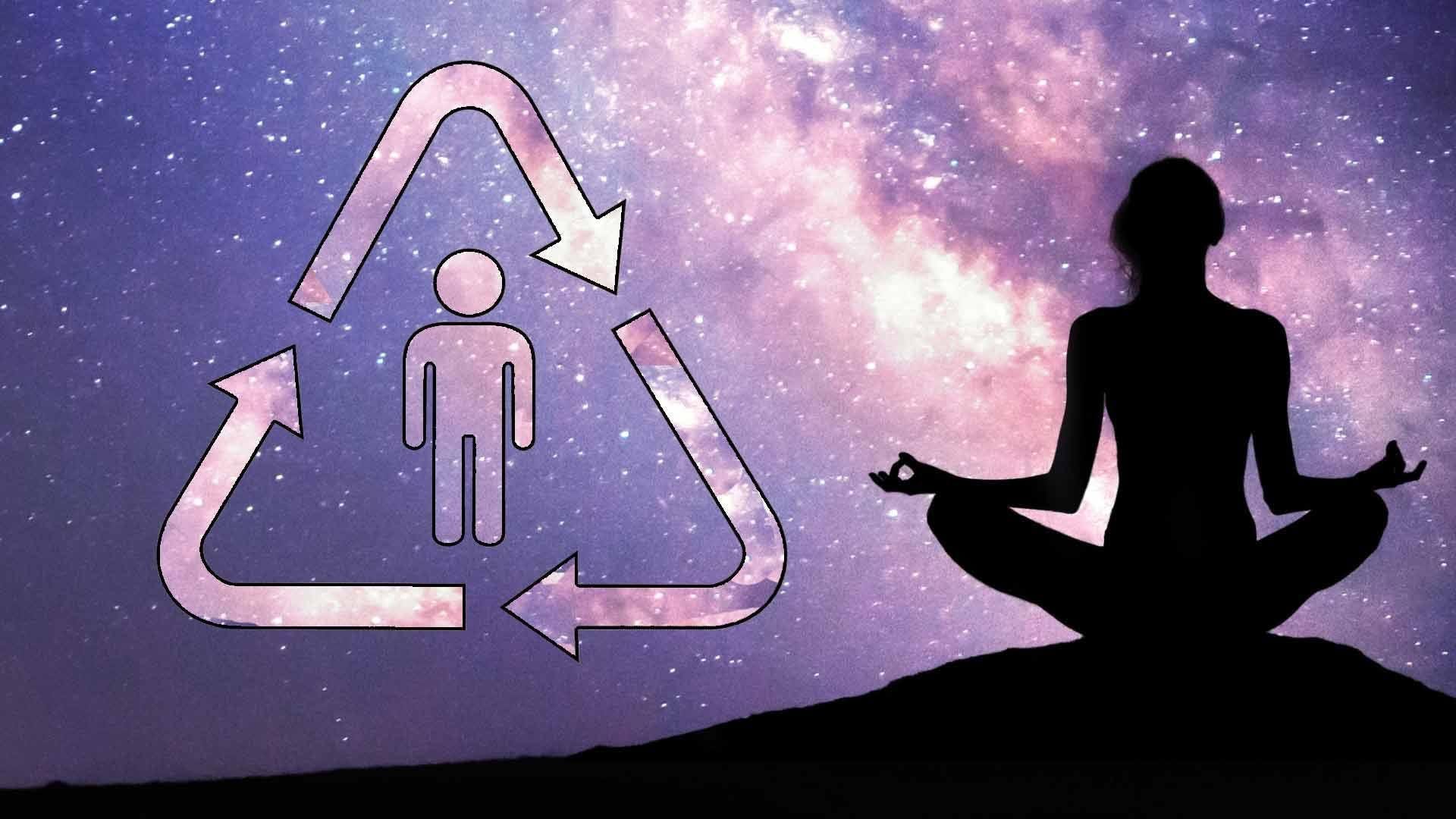
True Salvation is Based, Not on Man’s Effort to Reach Perfection, But Rather, on God’s Effort to Reach Man

Teachers of Far Eastern religions (such as Buddhism, Hinduism, Jainism, and Sikhism) maintain that the process of reincarnation is necessary for the ‘reaping’ of what some call “the karmic debt.” This process supposedly determines the ongoing evolution of the soul. Every action produces either good or bad karma. Ordinarily, good karma cannot cancel bad karma (though some teach it can). Each cause must have its own effect.
The biblical worldview depicts man, caught in a sinful state, seeking God and trusting the Creator to condescend to his level. In response to man’s humility and repentance, God grants forgiveness, mercy, restoration, an imparted status of righteousness, and the gift of eternal life. The Far Eastern worldview depicts man being awakened out of a state of ignorance, then striving to ascend to a place of perfection through human effort. Though attempting to live a perfect life is certainly commendable, it is not possible.
No human being can be entirely free of imperfections, even if they are predominantly errors in thoughts or attitudes. The Bible encourages believers to be perfect even as the heavenly Father is perfect (Jesus preached that in the Sermon on the Mount), but it does not hinge salvation on actually attaining this goal. (See Matthew 5:48.)
The best, most concise way to end this point is to quote Ephesians 2:4-9:
“But God, who is rich in mercy, because of His great love with which He loved us, even when we were dead in trespasses, made us alive together with Christ (by grace you have been saved), and raised us together, and made us sit together in the heavenly places in Christ Jesus, that in the ages to come He might show the exceeding riches of His grace in His kindness toward us in Christ Jesus. For by grace you have been saved through faith, and that not of yourselves; it is the gift of God, not of works, lest anyone should boast.”
Regeneration vs. Reincarnation: How Jesus’ New Birth is Different Than Buddhism’s Reincarnation
Partly From an Exposition of Jeremiah 9:12-26
(By John Carpenter, Mar 15, 2026)
Some people understand that when you die, you are reincarnated, depending on how good or bad you’ve been, to a better life or a worse one. But the Bible says, “it is appointed to man once to die and after that comes the judgment” (Hebrews 9:27). You can’t understand this life if you think it’s just another one of many you’ll be living.
Jesus said, “You must be born again.” That’s the only way you can know God. This new birth is different from the idea of reincarnation. Reincarnation suggests we return to live another version of the same kind of life, trapped in the same cycle of the flesh. But being born again is not another of the same; it is the arrival of a new creation that begins in your heart. You do not need another life in this world; you need a new heart from the Spirit.
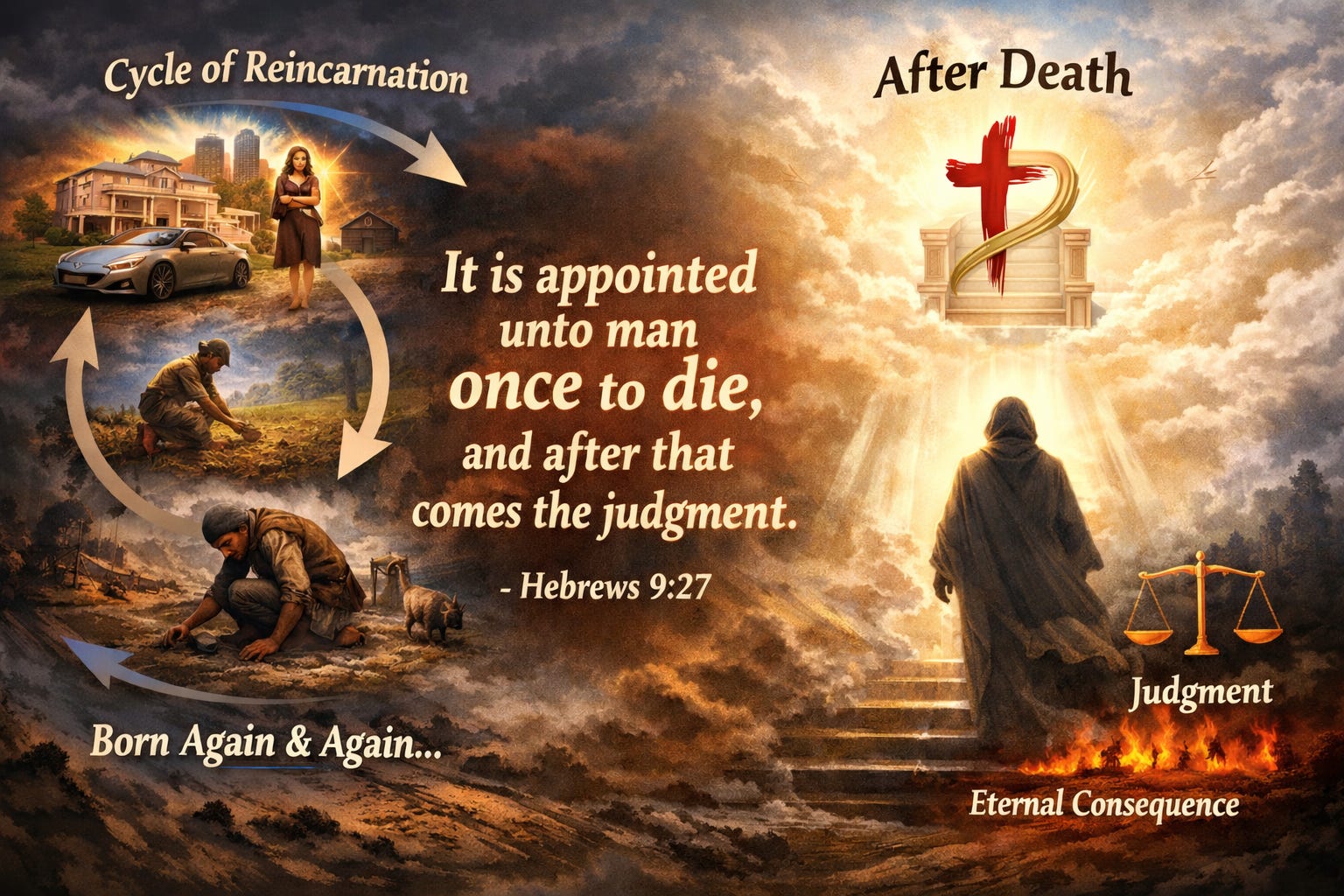
The Endless Treadmill of Samsara
In Buddhism, rebirth refers to the teaching that the actions of a sentient being lead to a new existence after death in an endless cycle called saṃsāra. This cycle isn’t a second chance at a carefree life; it is considered to be dukkha—unsatisfactory and painful. The cycle stops only if Nirvana (liberation) is achieved by insight and the extinguishing of craving.
This rebirth doctrine is sometimes referred to as reincarnation or transmigration. Your destination is determined by karma. Good, skillful karma (kusala) favors a rebirth in good realms, while bad, unskillful karma (akusala) drops you into an evil one. Consequently, much of traditional Buddhist practice is centered on gaining merit to avoid the nightmare of a lesser existence. It is a relentless, cyclical treadmill of human effort.
The Finality of One Life
Hebrews 9:27 provides a direct biblical contradiction to the concept of reincarnation: “it is appointed for man to die once, and after that comes judgment.” Human life does not consist of a cycle of repeated earthly existences but of a single life followed by divine judgment. The biblical pattern is linear—life, death, judgment—not cyclical. Just as human beings die once, so Christ also died once for sins. His sacrifice is effective precisely because it is not repeated, and human life likewise is not repeated in multiple incarnations.
Furthermore, the idea of reincarnation collapses under the problem of consciousness and personal identity. Reincarnation imagines that the same “person” returns in another body, yet there is ordinarily no memory connecting these supposed lives. As a result, reincarnation amounts to the eternal recurrence of the amnesiac: a succession of disconnected lives with no conscious continuity. If a later “life” remembers nothing of the earlier one, then in any meaningful sense the earlier person has simply died. Hebrews 9:27 assumes the opposite—that a single personal life is lived, and the same conscious person who dies is the one who stands before God in judgment. Reincarnation dissolves responsibility by scattering identity across imagined lives, but Hebrews insists that our one earthly life carries eternal significance.
What’s It Take? A Spiritual Birth
So, what does it take to get into God’s Kingdom? When Jesus discussed this with a religious leader named Nicodemus, Nicodemus took Jesus’ words very literally (John 3:1-15). He asked if we really have to go back to being a baby and be physically born all over again. But Jesus explained that it takes a spiritual birth that comes about by the Holy Spirit. You cannot control it, manipulate it, or earn it, just as you cannot control the wind.
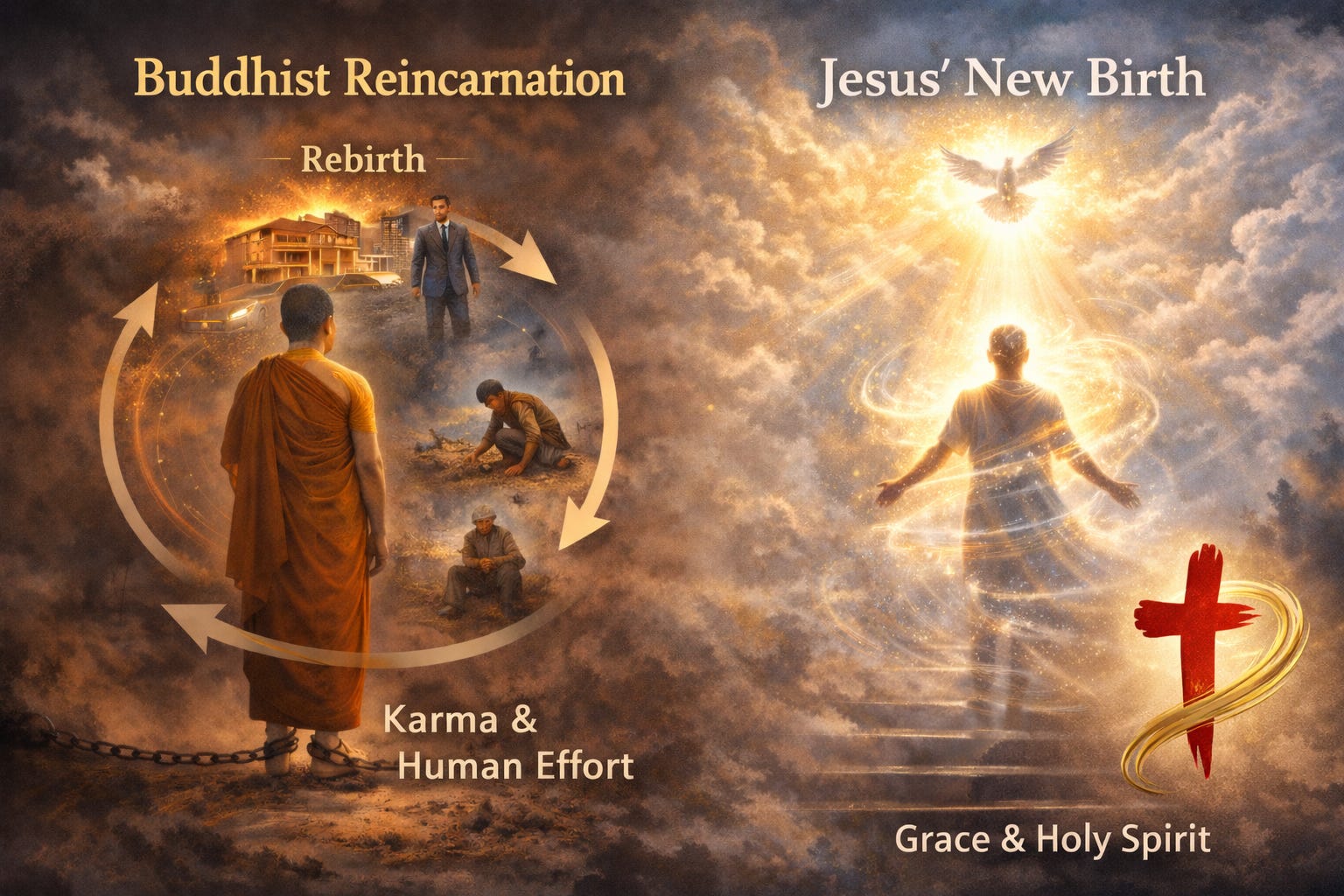
We are not saved because of the righteous things we have done, or by accumulating good karma. Jesus saved us by His grace. He washed us, regenerated us, and renewed us by the Holy Spirit whom He poured out on His people lavishly (Titus 3:5).
A New Heart Now
This is the doctrine of regeneration. Stephen Charnock defined regeneration as “a mighty and powerful change, wrought in the soul by the efficacious working of the Holy Spirit wherein a vital principle, a new habit, the law of God, and a divine nature are put into, and framed in the heart.”
Anthony Hoekema similarly defined regeneration “as that work of the Holy Spirit whereby he initially brings persons into living union with Christ, changing their hearts so that they who were spiritually dead become spiritually alive, now able and willing to repent of sin, believe the gospel, and serve the Lord.” Or, as Wayne Grudem succinctly puts it, it is “A secret act of God in which he imparts new spiritual life to us.”
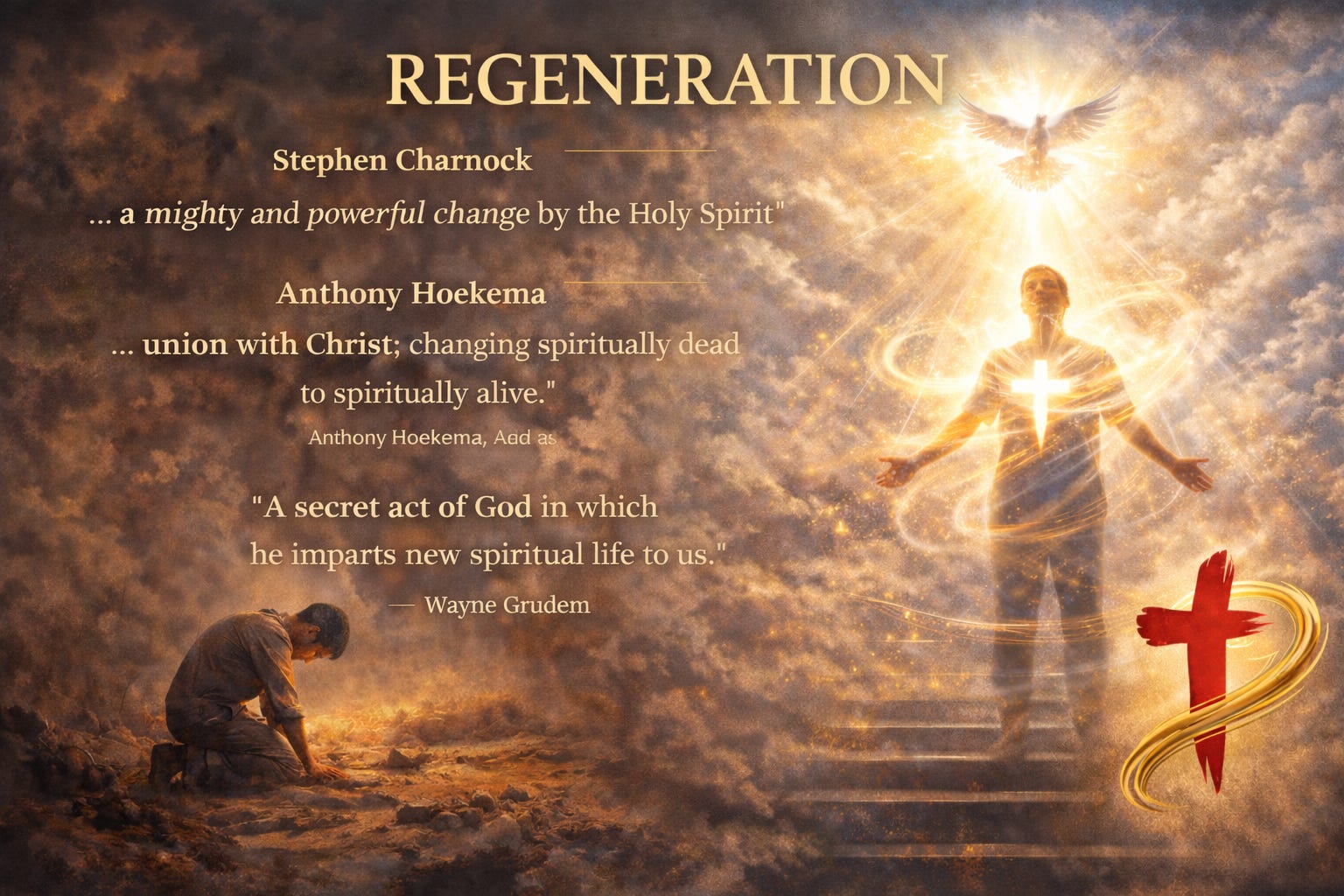
These complementary definitions show that regeneration isn’t about a cycle of reliving this life over and over again; it is about getting a new heart right now. And why did He do this? To purify for Himself a people who are zealous for good works.
When you are baptized in the Spirit, you are saved not just from the penalty of death, but from the power of sin. You will not be perfect yet, but you will finally possess a heart that delights in the same things the Lord delights in: steadfast love, justice, and righteousness, in understanding and knowing the Lord. When you are born again, that will be delightful to you.