
The Aether Conspiracy: How Science Conceals Spirit by Steven A. Young, Ph.D. and Aether Versus Atomism: The Properties and Attributes of Fields, Light, Matter, Space, and Time by Gregory Garrett

Steven A. Young, Ph.D.:
“The Aether/Ether, or the Fifth Element, is perhaps the single most crucial concept in achieving a complete understanding of the natural world. It is quite literally the one thing that ties together all other things.
But since the turn of the 20th century, it has been systematically erased from the canon of scientific knowledge, forced out of the club by the high priests of quantum theory, deemed unworthy, ‘superfluous’, and mere primitive superstition.
Yet history has shown that they are lost without it, forced to bring it back into their theories, disguised as newfangled discoveries like ‘dark matter’, ‘the zero point field’, ‘the space-time continuum’, ‘the quantum foam’ and so on. They are afraid to mention it by name, as it would cause the foundations of modern physics to crumble underfoot.
In this presentation, I dive into the full conspiracy of how it was voted out of physics based on a single failed experiment, despite masses of evidence in favour of it, and a long history of being the mainstream, established, respected view of natural philosophy in all the world’s cultures.”
The Aether Conspiracy - How Science Conceals Spirit:

Aether Versus Atomism: The Properties and Attributes of Fields, Light, Matter, Space, and Time by Gregory Lessing Garrett
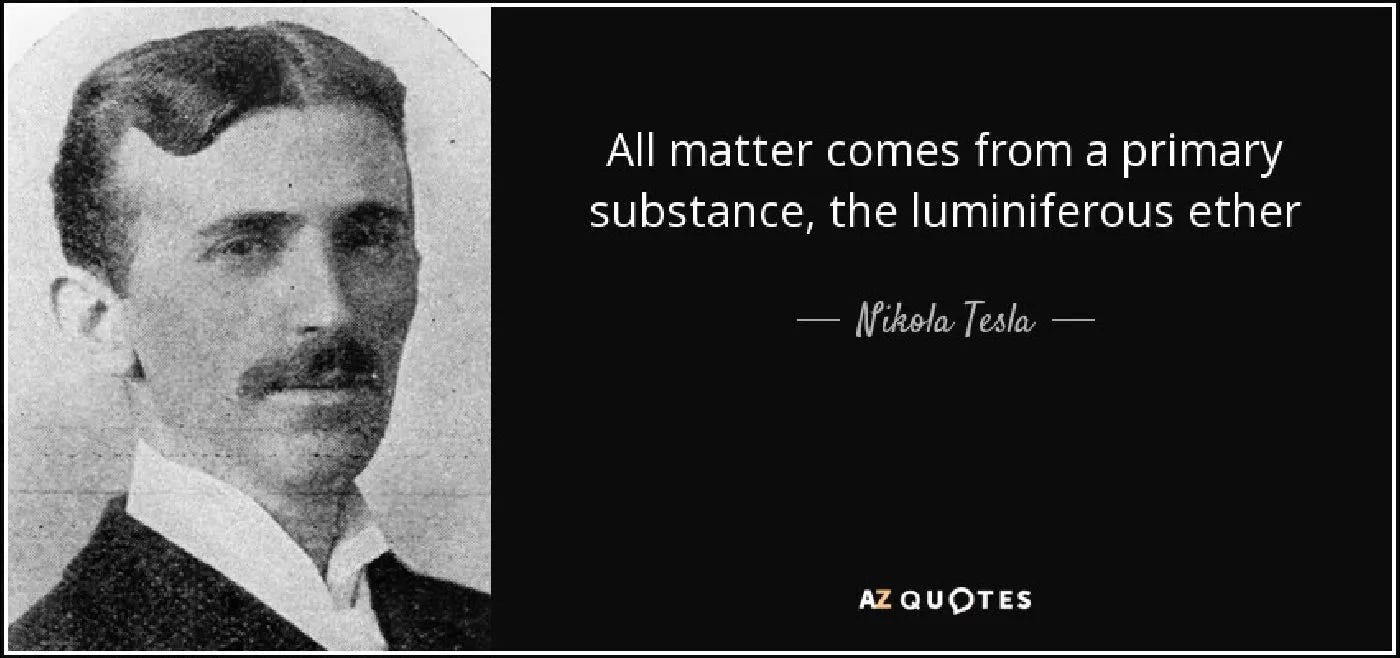
Aether exists as the substrate, or foundation, to all Physics. Aether is a tenable and substantiated concept, whereas Atomism is an untenable and unsubstantiated claim.
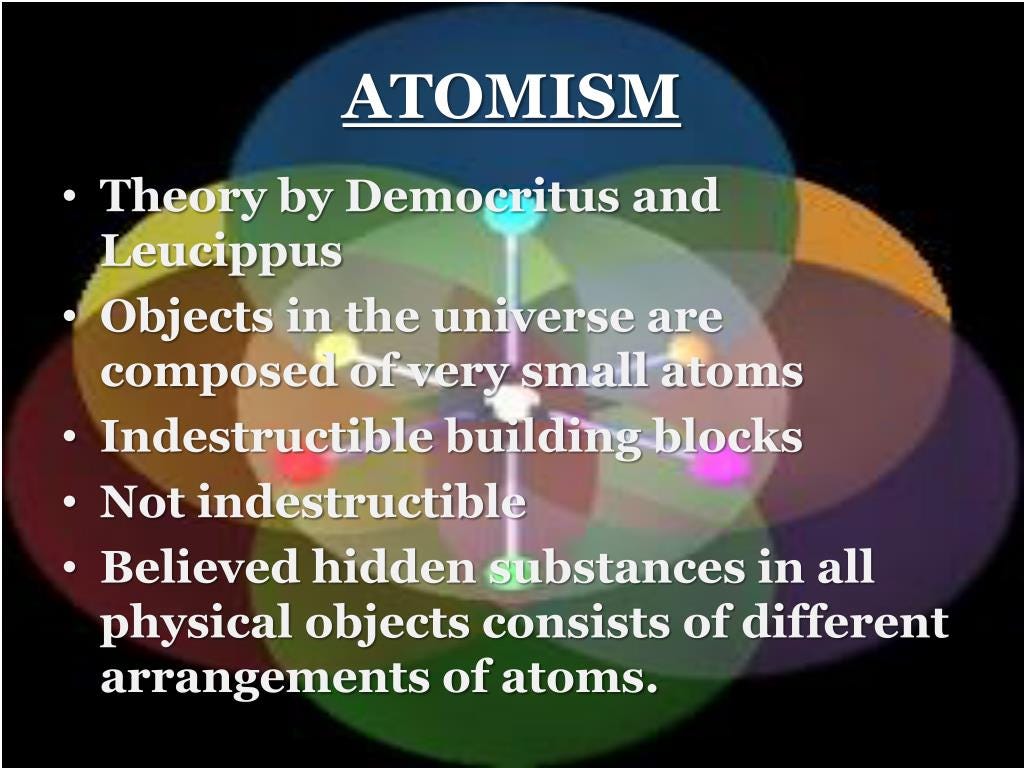
Mathematics is a religion based upon Atheistic Atomism, where everything is a particle and submits to quantization. If you cannot count it, Atomistic mathematicians will reject its realty.
They will reject the field of Aether that unites all dimensional attributes, substrates, properties, and events because they cannot readily quantize it. You can’t quantize a field.
Key Aspects of the Aether Element:
· Definition: Also known as quintessence (”fifth essence”), it represents the spiritual essence, space, or “void” that fills the heavens and connects all things.
· Cosmology: Aristotle proposed it as a distinct fifth element from the terrestrial four, forming The Cosmos beyond The Earth.
· Mythology: In Greek mythology, it was the “pure essence” breathed by gods, distinct from the air breathed by mortals.
· Scientific History: Used to explain natural phenomena like gravity and light; it was later thought of as the medium for light waves in the 18th/19th centuries before being confirmed by modern physics (e.g., The Michelson-Morley experiment).
· Alternative Beliefs: Often associated with the dodecahedron Platonic solid and considered the “fifth element” in Ayurveda (as Akasha or space).
· Metaphysical/Symbolic: Represents Spirit or the connecting force between the other four elements.
1) Light can only travel at its luminal velocity as defined by the dielectric medium and its dimensional relationship to certain terminal limitations.
2) The “speed of light” is a fictional idea, and not a constant. It is medium-dependent and changes “velocity” depending upon the density of the medium in which it passes via field perturbation.
3) Likewise, Electromagnetic or Magnetic induction is the production of an electromotive force across an electrical conductor in a changing magnetic field. Hence, Light, Magnetism, and Sound are all Aetheric field perturbation dependent in their transmission, and not the result of particles or waves in motion.
4) There is no speed of light or speed of sound since neither move. They are merely the result of induction through the Aetheric medium, which is singular and not dualistic in nature.
5) Light is not a material construct, but rather the epiphenomenal perturbation of the Aether via field induction.
6) Light is a compound co-axial circuit.
7) It’s an Aether perturbation modality.
8) All fields are Aether perturbation modalities.
9) There is no energy in matter, other than what is conferred to it by virtue of its existence within The Aetheric field, as Nikola Tesla clearly pointed out.
10) Space cannot bend or warp since, by definition, it possesses no salient or measurable properties, and therefore, is not malleable.
11) Time does not exist other than as a mental construct. Time is measurement, not a real thing.
12) Wireless technology is evidence of the Aetheric field, and not of an Atomistic, particle-based world.
13) The frequency and wavelength of Light are a function of Aetheric pulse perturbation.
14) Everything is Light.
15) Hydrostatic equilibrium suggests a model for understanding perturbations in The Aetheric field, culminating in what are called “Photons”, which possess non-material field induction properties.
16) Light is a sound wave in The Aether.
17) Photons do not travel in The Aether. Rather, nothing is moving from point “A” to point “B”. Light is merely the rate of disturbance in The Aether, which is measured as wave propagation.
18) The conjugation between the magnetic and the dielectric is real.
19) Everywhere you see is Light, that is a construct of magnetism.
20) Everywhere you see Darkness, this is a construct of the dielectric. (i.e., electrically insulative).
21) Magnetism is a dielectric field.
22) Gravity, misnamed, is merely a property of dielectric differentials in The Aether, in conjunction with the “molecular density” and buoyancy conferred to objects by the electromagnetic and dielectric properties of The Aetheric field.
23) Light is the result of constructive and destructive interference in The Aetheric field.
24) Light is the result of the interrelationship between the magnetic and the dielectric, resulting in a hyper-trochoidal pattern.
25) The reason the Earth’s Aetheric field exhibits Trochoidal patterns is that it is electromagnetically oriented.
26) The curve described by a fixed point on the radius or extended radius of a circle as the circle rolls along a straight line creates a Trochoidal pattern.
27) The Earth exists in the Toroidal Vortex created by the interplay between magnetic and dielectric fields.
28) Quantum Mechanics, Quantum Field Theory, and General and Special Relativity are pseudo-sciences created to mask the existence of Aether.
29) Most ancient architecture was created to tap into the Aetheric Field and extract, conduct, and channel electromagnetic energy from the Ionosphere, which is not actually a sphere, but rather, a layer of electromagnetic field induction. Electromagnetic or magnetic induction is the production of an electromotive force across an electrical conductor in a changing magnetic field. Michael Faraday is generally credited with the discovery of induction in 1831, and James Clerk Maxwell mathematically described it as Faraday’s Law of Induction. Ancient towers, cathedrals, castles, pyramids, obelisks, etc… were all created, in part, for this purpose.
30) Atomism is a religion. It’s the cult of bumping particles.
31) The electron’s discoverer, J.J. Thomson, called it one unit of dielectric induction During the 1880s and ‘90s scientists searched cathode rays for the carrier of the electrical properties in matter. Their work culminated in the discovery by English physicist J.J. Thomson of the electron in 1897. He found a green glow on the wall of his glass tube and attributed it to rays emanating from the cathode via induction, not particles.
32) Light is neither a wave nor a particle. These are just conceptual abstractions. They are not what things are. These conceptual abstractions describe what things do…how things behave as the Aether experiences perturbation.
33) Physicist, Robert B. Laughlin, wrote: “It is ironic that Einstein’s most creative work, the general theory of relativity, should boil down to conceptualizing space as a medium when his original premise [in Special Relativity] was that no such medium existed. The word ‘Aether’ has extremely negative connotations in theoretical physics because of its past association with opposition to Relativity. This is unfortunate because, stripped of these connotations, it rather nicely captures the way most physicists actually think about the hypothetical Quantum Vacuum. Relativity actually says nothing about the existence or nonexistence of matter pervading the universe, only that any such matter must have relativistic symmetry. It turns out that such matter exists. About the time Relativity was becoming accepted, studies of radioactivity began showing that the empty vacuum of space had spectroscopic structure similar to that of ordinary quantum solids and fluids. Subsequent studies with large particle accelerators have now led us to understand that space is more like a piece of window glass than ideal Newtonian emptiness. It is filled with ‘stuff’ that is normally transparent but can be made visible by hitting it sufficiently hard to knock out a part. The modern concept of the vacuum of space, confirmed every day by experiment, is a Relativistic Aether. But we do not call it this because it is taboo.”
34) Objects in the world react with Piezoelectricity, as in the electric charge that accumulates in certain solid materials—such as crystals, certain ceramics, and biological matter such as bone, DNA, and various proteins—in response to applied mechanical stress. The word Piezoelectricity means electricity resulting from pressure and latent heat. It is derived from the Greek word piezein, which means to squeeze or press, and ēlektron, which means amber, an ancient source of electric charge.
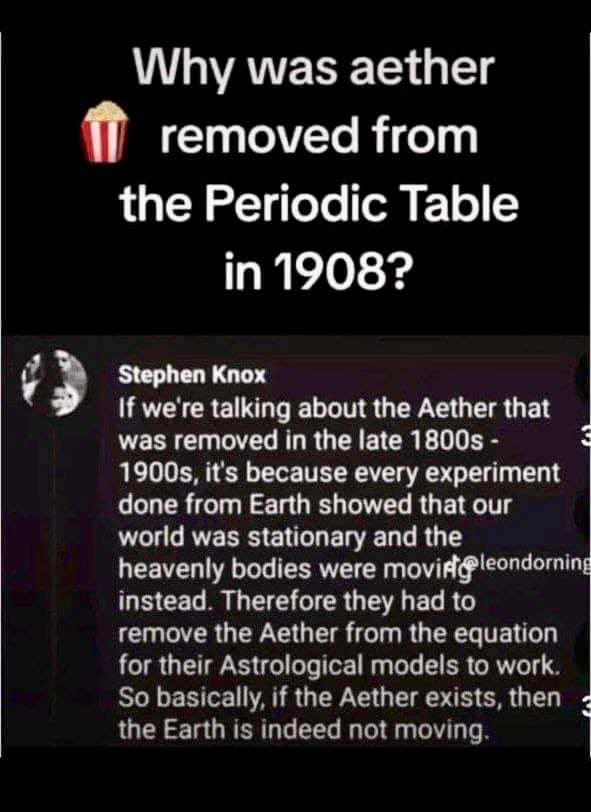
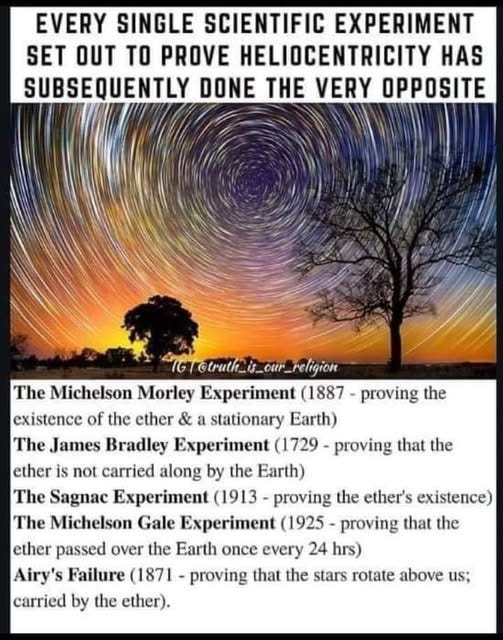
Proof of a Stationary Motionless Earth and Aether
For those who say they believe and trust in Science, here are Five Famous, but hidden from “education” Peer-reviewed Significant Scientific Experiments, of true Science, using the scientific method, that prove with absolutely irrefutable scientific certainty that the Earth is stationary and motionless as well as proving the existence of the Aether, containing the stars that revolve above the Earth, as the necessary medium always required in which light waves must travel.
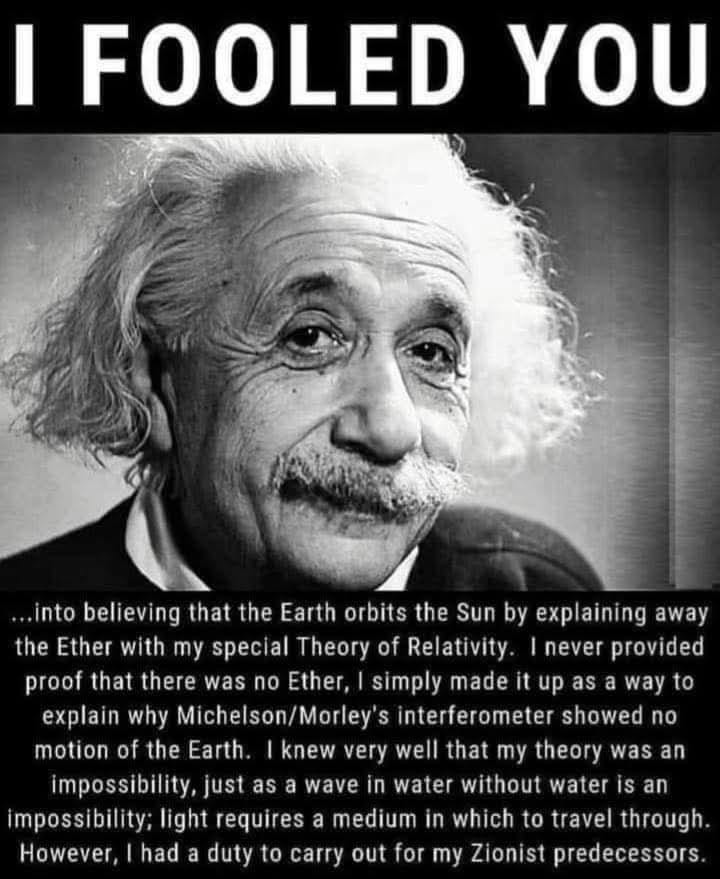
These scientific experiments demolish Einstein’s theory of relativity, and by extension, gravity, the spinning globe and the heliocentric model, not to mention the Big Bang theory as well as the theory of Evolution. Conversely, not ONE single scientific experiment has ever detected, never mind proven, a rotating, nor orbiting, globe Earth.
All inconvenient implications of scientific experiments that have proven a stationary, motionless Earth, however, have been discarded & swept under the rug of the shocked scientific establishment, to uphold at all cost, the pseudo-scientific, proofless theory and religious blind faith belief in the Copernican principle and heliocentric model.
Obviously, due to the questions that would inevitably arise, resulting in the whole proofless Heliocentric spinning globe theory falling apart, these experiments are not taught in schools or Universities, unless simply mentioned as allegedly incorrect theories, that were conveniently replaced when Einstein came along and simply announced that the Aether did not exist, with no evidence what-so-ever to support or prove his claim, because of the inconvenient reality that these experiments in fact proved.
5 Hidden Peer-reviewed Scientific Experiments that prove a stationary motionless Earth:
Luminiferous Aether
Luminiferous Aether (”luminiferous”, meaning “light-bearing”) was the postulated medium for the propagation of light. It was invoked to explain the ability of the apparently wave-based light to propagate through empty space (a vacuum), something that waves should not be able to do. The assumption of a spatial plenum of luminiferous Aether, rather than a spatial vacuum, provided the theoretical medium that was required by wave theories of light.
The Aether hypothesis was the topic of considerable debate throughout its history, as it required the existence of an invisible and infinite material with no interaction with physical objects. As the nature of light was explored, especially in the 19th century, the physical qualities required of an Aether became increasingly contradictory. By the late 1800s, the existence of the Aether was being questioned, although there was no physical theory to replace it.
Isaac Newton suggests the existence of an Aether in the Third Book of Opticks (1st ed. 1704; 2nd ed. 1718):
“Doth not this Aethereal medium in passing out of water, glass, crystal, and other compact and dense bodies in empty spaces, grow denser and denser by degrees, and by that means refract the rays of light not in a point, but by bending them gradually in curve lines? Is not this medium much rarer within the dense bodies of the Sun, stars, planets and comets, than in the empty celestial space between them? And in passing from them to great distances, doth it not grow denser and denser perpetually, and thereby cause the gravity of those great bodies towards one another, and of their parts towards the bodies; everybody endeavoring to go from the denser parts of the medium towards the rarer?”
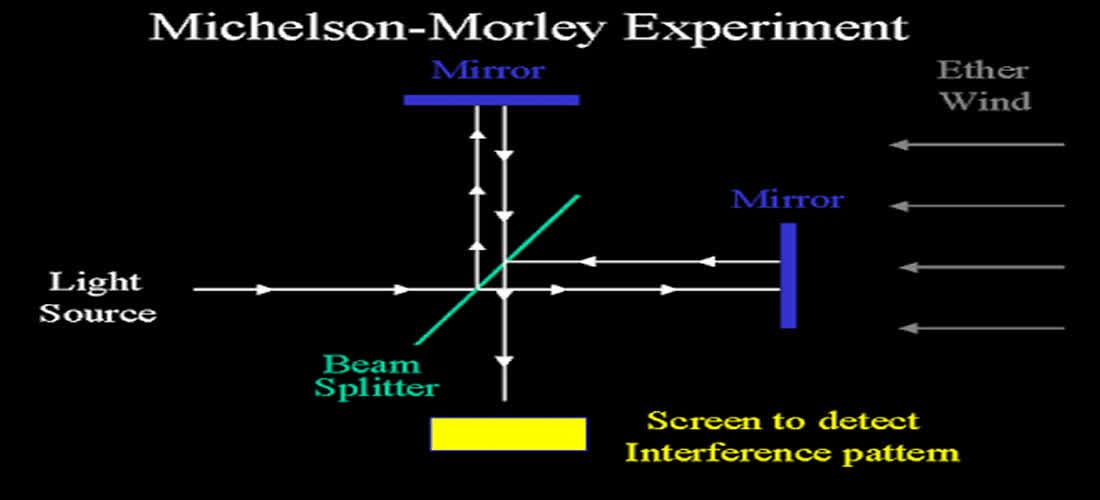
In the 19th century, luminiferous Aether (or ether), meaning light-bearing Aether, was a theorized medium for the propagation of light. James Clerk Maxwell developed a model to explain electric and magnetic phenomena using the Aether, a model that led to what are now called Maxwell’s equations and the understanding that light is an electromagnetic wave. However, a series of increasingly complex experiments had been carried out in the late 1800s like the Michelson–Morley experiment in an attempt to detect the motion of Earth through the Aether, and had failed to do so. A range of proposed Aether-dragging theories could explain the null result but these were more complex, and tended to use arbitrary-looking coefficients and physical assumptions. Joseph Larmor discussed the Aether in terms of a moving magnetic field caused by the acceleration of electrons.
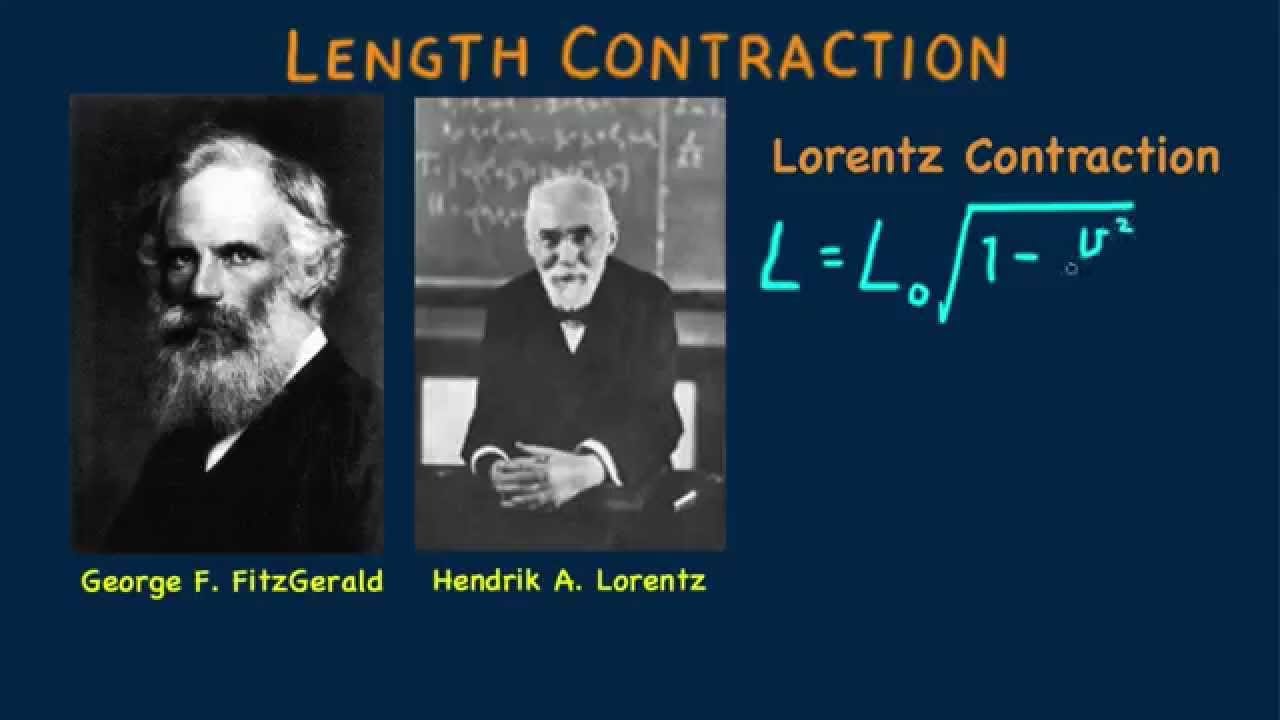
Hendrik Lorentz and George Francis FitzGerald offered within the framework of Lorentz ether theory an explanation of how the Michelson–Morley experiment could have failed to detect motion through the Aether. However, the initial Lorentz theory predicted that motion through the Aether would create a birefringence effect, which Rayleigh and Brace tested and failed to find (Experiments of Rayleigh and Brace). All of those results required the full application of the Lorentz transformation by Lorentz and Joseph Larmor in 1904.
Summarizing the results of Michelson, Rayleigh and others, Hermann Weyl would later write that the Aether had “betaken itself to the land of the shades in a final effort to elude the inquisitive search of the physicist”.[8] In addition to possessing more conceptual clarity, Albert Einstein’s 1905 special theory of relativity could explain all of the experimental results without referring to an Aether at all. This eventually led most physicists to conclude that the earlier notion of a Luminiferous Aether was not a useful concept.
Atomism
A number of important theorists in ancient Greek natural philosophy held that the universe is composed of physical ‘atoms’, literally ‘uncuttables’. Some of these figures are treated in more depth in other articles in this encyclopedia: the reader is encouraged to consult individual entries on Leucippus, Democritus, Epicurus and Lucretius. These philosophers developed a systematic and comprehensive natural philosophy accounting for the origins of everything from the interaction of indivisible bodies, as these atoms—which have only a few intrinsic properties like size and shape—strike against one another, rebound and interlock in an infinite void. This atomist natural philosophy eschewed teleological explanation and denied divine intervention or design, regarding every composite of atoms as produced purely by material interactions of bodies, and accounting for the perceived properties of macroscopic bodies as produced by these same atomic interactions. Atomists formulated views on ethics, theology, political philosophy and epistemology consistent with this physical system. This powerful and consistent materialism, somewhat modified from its original form by Epicurus, was regarded by Aristotle as a chief competitor to teleological natural philosophy.
Since the Greek adjective atomos means, literally, ‘uncuttable,’ the history of ancient atomism is not only the history of a theory about the nature of matter, but also the history of the idea that there are indivisible parts in any kind of magnitude—geometrical extension, time, etc. Although the term ‘atomism’ is most often identified with the systems of natural philosophy mentioned above, scholars have also identified commitments to indivisibles in a number of lesser known figures. Often these are formulated in response to paradoxes like those of Zeno of Elea (early 5th c. BCE) about infinite divisibility of magnitudes. Some of these identifications of other kinds of atomism outside the main tradition are controversial and based on slight evidence.
More on Atomism
Atomism [a privative and temnein to cut, i.e. indivisible] is the system of those who hold that all bodies are composed of minute, indivisible particles of matter called atoms.
We must distinguish between:
1) Atomism as a philosophy
2) Atomism as a theory of science
Atomism as a philosophy originated with Leucippus. Democritus (b. 460 B.C.), his disciple, generally considered the father of atomism, as practically nothing is known of Leucippus. The theory of Democritus may be summed up in the following propositions:
All bodies were thought to be composed of atoms and spaces between the atoms.
In the philosophy of Atomism, Atoms are eternal, indivisible, infinite in number, and homogeneous in nature; all differences in bodies are due to a difference in the size, shape or location of the atoms.
There is no purpose or design in nature, and in this sense all is ruled by chance.
All activity is reduced to local motion.
The formation of the universe is due to the fact that the larger atoms fall faster, and by striking against the smaller ones combine with them; thus the whole universe is the result of the fortuitous concourse of atoms. Countless worlds are formed simultaneously and successively. Epicurus (342-270 B. C.) adopted the theory of Democritus, but corrected the blunder, pointed out by Aristotle, that larger atoms fall faster than smaller ones in vacuo. He substituted a power in the atoms to decline a little from the line of fall. Atomism is defended by Lucretius Carus (95-51 B.C.) in his poem, “De Rerum Naturâ.”
With the exception of a few alchemists in the Middle Ages, we find no representatives of atomism until Gassendi (1592-1655) renewed the atomism of Epicurus. Gassendi tried to harmonize atomism with Christian teaching by postulating atoms finite in number and created by God. With the application of atomism to the sciences, philosophic atomism also revived, and became for a time the most popular philosophy. Present-day philosophic atomism regards matter as homogeneous and explains all physical and chemical properties of bodies by a difference in mass of matter and local motion. The atom itself is inert and devoid of all activity. The molecule, taken over from the sciences, is but an edifice of unchangeable atoms. Philosophic atomism stands entirely on the basis of materialism, and, though it invokes the necessary laws of matter, its exclusion of final causes makes it in the last analysis a philosophy of chance.
The atomic theory was first applied to chemistry by Dalton (1808), but with him it meant little more than an expression of proportions in chemical composition. The theory supplied a simple explanation of the facts observed before him: that elements combine in definite and multiple proportions. The discovery in the same year by Gay-Lussac of the law that gases under the same pressure and temperature have equal volumes was at the same time a confirmation and an aid in determining atomic weights. Avogadro’s law (1811) that gases under the same conditions of pressure and temperature have an equal number of molecules, and the law of Petit and Dulong that the product of the specific heat and atomic weight of an element gives a constant number were further confirmations and aids. The atomic theory was soon applied to physics, and is today the basis of most of the sciences. Its main outlines are: Matter is not continuous but atomically constituted. An atom is the smallest particle of matter that can enter a chemical reaction. Atoms of like nature constitute elements, those of unlike nature constitute compounds. The elements known today are about 76 in number and differ from one another in weight and physical and chemical properties. Atoms combine to form molecules, which are the smallest quantities of matter that can exist in a free state, whether of an element or a compound. Some believe that the atom retains its individuality in the molecule, whilst others consider the molecule homogeneous throughout. The theoretic formulas of structure of Frankland suppose them to remain. The spaces between the atoms are filled with an imponderable matter called ether. Upon the nature of ether the greatest differences of opinion exist. The adoption by scientists of Maxwell’s theory of light seems to render the ether-hypothesis with its many contradictions superfluous. At all events it is quite independent of the atomic theory.
The results obtained by the Hungarian Lenard, the English physicist J.J. Thomson, and many others, by means of electric discharges in rarified gases, the discovery of Hertzian waves, a better understanding of electrolysis and the discovery of radium by Madame Curie have made necessary a modification of the atomic theory of matter. The atom, hitherto considered solid and indivisible, is now believed to break up into ions or electrons. This new theory, however, must not be considered as opposed to the atomic theory; it comes rather as an extension of it. In chemistry, the principal field of the atomic theory, the atom will still remain as the chemically indivisible unit. The hypothesis of subatoms is, moreover, not entirely new; it was proposed by Spencer as early as 1872 (”Contemporary Rev.”, June, 1872) and defended by Crookes in 1886.
The physico-chemical theory of atomism, though not a demonstrated truth, offers a satisfactory explanation of a great number of phenomena, and will, no doubt, remain essentially the same, no matter how it may be modified in its details. In chemistry, it does not stop arbitrarily in the division of matter, but stops at chemical division. If another science demands further division, or if philosophy must postulate a division of the atom into essential principles, that is not the concern of chemistry. Science has no interest in defending the indivisible atom of Democritus.
Scholastic philosophy finds nothing in the scientific theory of atomism which it cannot harmonize with its principles, though it must reject the mechanical explanation, often proposed in the name of science, which looks upon the atom as an absolutely inert mass, devoid of all activities and properties. Scholastic philosophers find in the different physical and chemical properties of the elements an indication of specifically different natures. Chemical changes are for them substantial changes, and chemical formulas indicate the mode in which the elements react on one another in the production of the compound. They are not a representation of the molecular edifice built up of unchangeable atoms. Some would accept even this latter view and admit that there are no substantial changes in inanimate nature (Gutberlet). This view can also be harmonized more easily with the facts of stereochemistry. As regards the phenomena observed in radio-activity, a generalization, either in the materialistic sense, that all matter is homogeneous, or in the scholastic sense, that all elements can be changed into one another, is in the present state of science premature.
-- https://www.newadvent.org/cathen/02053a.htm
Dielectric
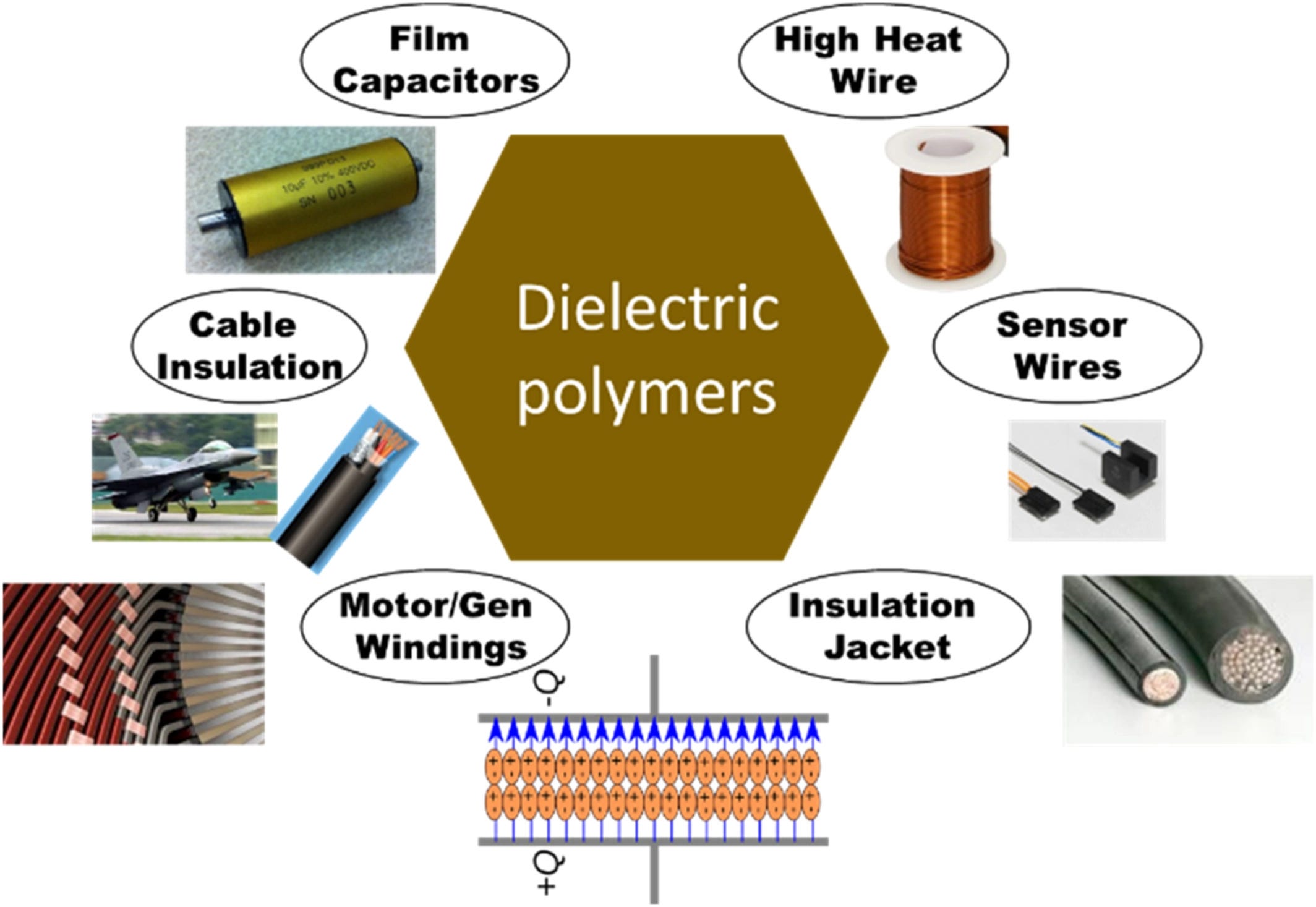
In electromagnetism, a dielectric (or dielectric material or dielectric medium) is an electrical insulator that can be polarized by an applied electric field. When a dielectric material is placed in an electric field, electric charges do not flow through the material as they do in an electrical conductor, because they have no loosely bound, or free, electrons that may drift through the material, but instead, they shift, only slightly, from their average equilibrium positions, causing dielectric polarization. Because of dielectric polarization, positive charges are displaced in the direction of the field, and negative charges shift in the direction opposite to the field (for example, if the field is moving parallel to the positive x axis, the negative charges will shift in the negative x direction). This creates an internal electric field that reduces the overall field within the dielectric itself. If a dielectric is composed of weakly bonded molecules, those molecules not only become polarized, but also reorient so that their symmetry axes align to the field.
Piezoelectricity
Piezoelectricity is the electric charge that accumulates in certain solid materials—such as crystals, certain ceramics, and biological matter such as bone, DNA, and various proteins—in response to applied mechanical stress. The word Piezoelectricity means electricity resulting from pressure and latent heat. It is derived from the Greek word piezein, which means to squeeze or press, and ēlektron, which means amber, an ancient source of electric charge.
The Piezoelectric effect results from the linear electromechanical interaction between the mechanical and electrical states in crystalline materials with no inversion symmetry. The Piezoelectric effect is a reversible process: materials exhibiting the Piezoelectric effect also exhibit the reverse Piezoelectric effect: the internal generation of a mechanical strain resulting from an applied electrical field. For example, lead zirconate titanate crystals will generate measurable Piezoelectricity when their static structure is deformed by about 0.1% of the original dimension. Conversely, those same crystals will change about 0.1% of their static dimension when an external electric field is applied. The inverse Piezoelectric effect is used in the production of ultrasound waves.
French physicists Jacques and Pierre Curie discovered Piezoelectricity in 1880. The Piezoelectric effect has been exploited in many useful applications, including the production and detection of sound, Piezoelectric inkjet printing, generation of high voltage electricity, as a clock generator in electronic devices, in microbalances, to drive an ultrasonic nozzle, and in ultrafine focusing of optical assemblies. It forms the basis for scanning probe microscopes that resolve images at the scale of atoms. It is used in the pickups of some electronically amplified guitars and as triggers in most modern electronic drums. The Piezoelectric effect also finds everyday uses, such as generating sparks to ignite gas cooking and heating devices, torches, and cigarette lighters.
--https://en.wikipedia.org/wiki/Piezoelectricity
Avoiding The Void: A Brief History of Nothing(ness)
We all know the aphorism that one can see a glass filled to the middle with water as half-full or half-empty, the optimistic versus the pessimistic views. What about an empty glass? Of course, everyone knows that it’s filled with air. Can we, however, contemplate total emptiness? And if we can, does it really exist? Is there such a thing as a complete void in Nature, the absence of everything? This question has occupied the minds of philosophers and physicists for a very long time. KC Cole, a past member of 13.7, wrote a wonderful book about the topic.
What we mean by “nothing” has radically changed over time. And of course, the meaning of nothing is deeply related to our notion of reality, a topic we’ve been exploring for the past few weeks. Total emptiness, if it exists, has foreboding undertones. Nothingness is scary. We want to fill it up with something. And it appears that we are in luck.
We tend to organize perceived reality in terms of opposites: day-night, light-dark, hot-cold, male-female, before-after, good-evil, life-death and so forth. The opposite of nothing is everything. In the dictionary, the proper word for a completely empty space is void. So, it is to the void that we turn as the complete absence of matter.
Imagine that we had a super-pump, capable of sucking out every single air molecule from a bottle. (Of course, this has to be an imaginary perfectly rigid bottle, for otherwise it would implode.) Is there a point where nothing would remain inside?
Already in ancient Greece the question incited passionate debate. Parmenides, a pre-Socratic philosopher from southern Italy, would say that “eon” permeates all that exists, representing immutable Being in its most abstract form. According to his view, the void would be an impossibility, since it would mean a place without eon and hence with non-Being. Against Parmenides and his disciples, Atomists such as Democritus and later Lucretius would say that everything is composed of atoms moving in the void. So, matter and no-matter coexist, and where atoms are missing there is emptiness.
Aristotle strongly disagreed with the “atomists.” To him, “Nature abhorred a vacuum”: the void was impossible. His logic went something like this: drop a marble on a glass containing water and into one containing honey. The marble’s falling speed is larger in the glass with water. Since the speed of an object moving in a material medium (air, water, honey, etc.) is inversely proportional to the medium’s density, Aristotle extrapolated that in a medium which is completely empty (zero density) the speed of an object would be infinite. That, to Aristotle, was absurd and hence no medium could be completely empty. He thus postulated the existence of the aether, an inert and eternal substance that filled all of space above the Earth.
In the early 17th century, Descartes suggested that the cosmos was filled with an aether-like substance that was able to sustain vortices similar to hurricanes. He used this notion to explain the orbits of planets around the Sun and of the Moon around the Earth (they would be carried around by the vortex like corks spiraling around an emptying drain). In his masterpiece the Principia, Newton proved Descartes wrong, arguing that if there was such a substance in space, it would cause so much friction that the planets would fall onto the Sun; orbits would be unstable. Space was empty after all.
But not for long.
When James Clerk Maxwell showed in the mid-1800s that light was an electromagnetic wave propagating at 300,000 kilometers per second. He also concluded that, as any good wave should, light should be waving on something material. But what? It couldn’t be dense at all, as Newton had shown. It had to be transparent, since we can see light from distant stars. It had to be rigid to allow for the propagation of fast waves. And it had to be weightless. So, the aether made a comeback, now dressed in the more precise language of science. When Michelson and Morley failed to see the aether in their famous 1887 experiment, a quiet sense of desperation spread through the physics community. Strange ideas were proposed to salvage the aether. Only in 1905 did Einstein prove that the aether was not needed to sustain the propagation of electromagnetic waves: they could propagate in vacuo, in the void.
Side by side with this emptiness, atoms were also seen as mostly empty: electrons orbited protons at huge distances. A famous image is that if we amplify a proton to the size of a cherry, an electron would be circling at a radius equivalent to that of the Dome of Saint Peter’s Basilica in the Vatican. More precisely, the size difference is of about 100,000. So, the vision of the ancient atomists had a grain of truth: atoms do move in the void. Or do they?
As the 20th century progressed, the image of particles as little billiard balls scattering off each other went through a deep revision. The fundamental change in approach wasn’t very new, dating back to the work of Faraday and Maxwell in the 19th century. It was the notion that fields permeate all of space, being connected to specific sources. For example, any massive body such as yourself creates a gravitational field that “spreads” throughout space and falls with the square of the distance. Similarly, electric charges also create their fields. Soon enough, fields were linked to all matter particles and to the forces connecting them (such as gravity and electromagnetism). In fact, particles began to be seen as excitations of fields, just as waves are excitations of a material medium. (Like a rock tossed on a pond.)
Physical reality is now seen as consisting of fundamental fields and their excitations. There is no such thing as empty space. Nobel laureate Frank Wilczek wrote an excellent popular book on this view, The Lightness of Being.
And just to make things even more interesting, in 1998 astronomers discovered that the whole of space is filled up with a mysterious entity which, for lack of a better name, is called dark energy. We don’t know what it is but know what it does: it accelerates the expansion of space itself, rushing galaxies away from each other. So, in a sense, Aristotle was right after all. Dark energy could be thought as a kind of aether, although we don’t know if this substance (if we can call it a substance) is eternal and immutable. It may very well spring from the fields that permeate space, its origins related to the quantum fuzziness that dictates atomic behavior. Whatever it is, it seems that the void is no more.
-- https://www.npr.org/sections/13.7/2010/11/17/131383533/avoiding-the-void-a-brief-history-of-nothing-ness
Nikola Tesla Quotes on Aether
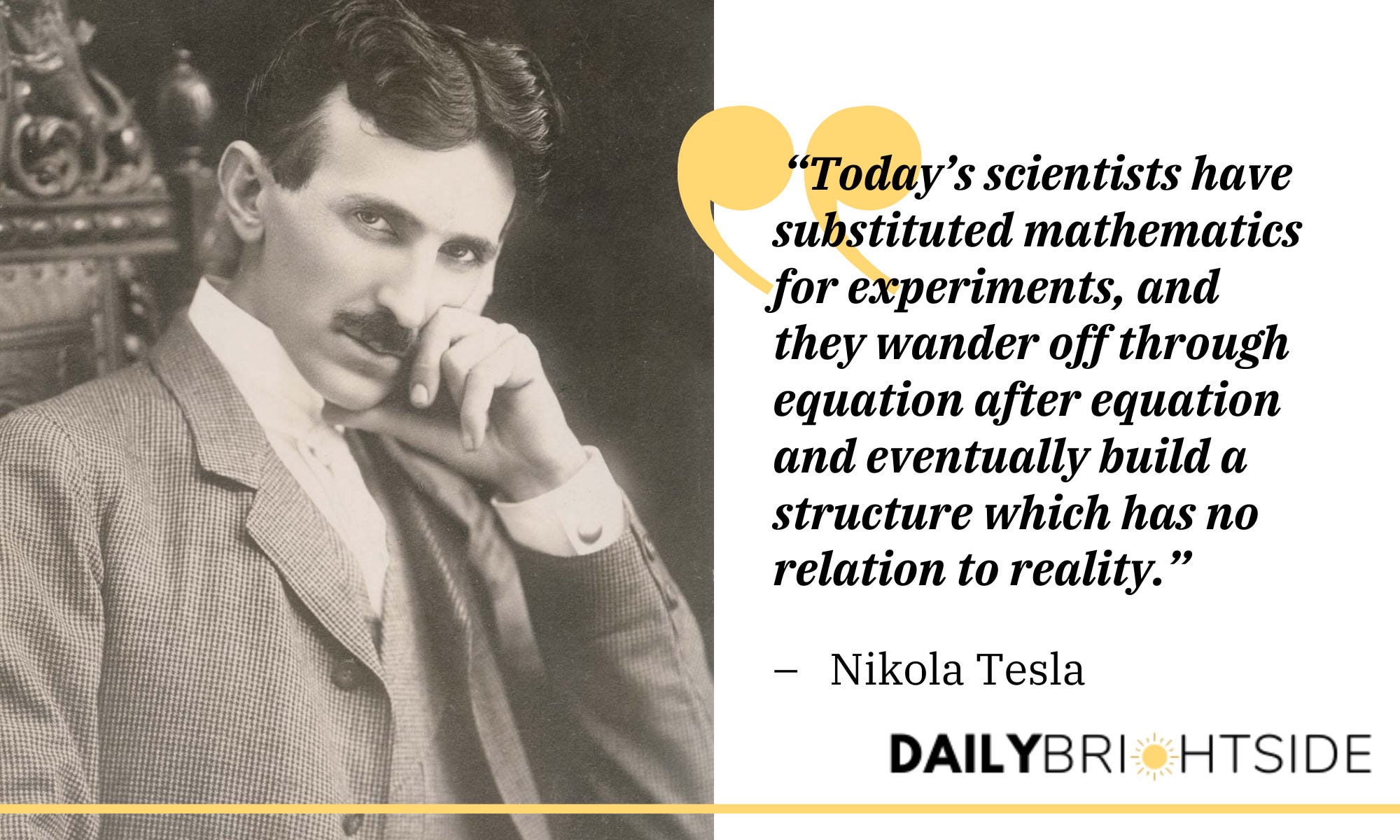
“There manifests itself in the fully developed being , Man, a desire mysterious, inscrutable and irresistible: to imitate nature, to create, to work himself the wonders he perceives.... Long ago he recognized that all perceptible matter comes from a primary substance, or tenuity beyond conception, filling all space, the Akasha or luminiferous Aether, which is acted upon by the life giving Prana or creative force, calling into existence, in never ending cycles all things and phenomena. The primary substance, thrown into infinitesimal whirls of prodigious velocity, becomes gross matter; the force subsiding, the motion ceases and matter disappears, reverting to the primary substance.”
--Nikola Tesla
This conceptualization of Aether matches Maxwell’s statements about Aether behaving as “Wheels and pulleys” and furthermore supports the Thompson (Lord Kelvin) vortex ring model of the atom, which is now being re-investigated through inviscid fluid dynamics.
--See Ross Anderson and Robert Brady of Cambridge
Excerpt from Tesla’s prepared statement for his 81st birthday (July 10, 1937):
“Only the existence of a field of force can account for the motions of the bodies as observed, and its assumption dispenses with space curvature. All literature on this subject is futile and destined to oblivion. So are all attempts to explain the workings of the universe without recognizing the existence of the ether and the indispensable function it plays in the phenomena. My second discovery was of a physical truth of the greatest importance. As I have searched the entire scientific record in more than a half dozen languages for a long time without finding the least anticipation, I consider myself the original discoverer of this truth, which can be expressed by the statement: There is no energy in matter other than that received from the environment.”
– Nikola Tesla
Once again, this indicates a vortex model of matter in which the energy of an atom is like the energy of a tornado: a localization of the energy of a larger system.
Various other quotes attributed to Tesla (of less-reliable/unknown source):
“A good example for such an interaction becomes apparent in gravitation, which should rather be named universal compression. I think the material bodies do not gravitate between each other, but it is the ether that makes one material body press against another.”
“We wrongly call this phenomenon gravitation.”
“We can also feel ether’s reaction when there is sudden acceleration or braking.”
“The stars, planets and all the universe appeared from the ether when some part of it, due to certain reasons, became less dense.”
“It can be compared with the formation of blebs [air bubbles] in boiling water, although such a comparison is only rough. The Aether tries to return itself to its initial state by compressing our world, but intrinsic electric charge within the material world substance obstructs this. It is similar to when the water compresses blebs [air bubbles] filled with hot water steam. Until the steam does get cold, the water is unable to compress the bleb. With time, having lost the intrinsic electric charge, our world will be compressed with the ether and is going to turn into Aether.”
“Having come out of the Aether once - so it will go back into the Aether.”
– Nikola Tesla
Transcript: The Aether Conspiracy - How Science Conceals Spirit
“All right. Well, welcome. And thank you for coming to this Patreon presentation about the Aether conspiracy. The Aether is a topic that’s come up a lot over the last few years and beyond. In my book and in my various presentations, it always gets a mention because it always fits into whatever it is we’re talking about.
It’s an important part of this whole conspiracy of science. And so I thought, So let’s get cracking then Now I want to start by just talking about this image of the bridge so this is where I live this is in Newport looking over the River Tay over to Dundee and I was born on the other side of that bridge but I grew up on this side of the bridge and I go out walking my dog every day and always see this view in lots of different ways now I had a synchronicity like last year sometime where I had two people referred to me as a bridge within the space of a couple of days. I thought it was pretty weird. No one’s ever called me a bridge before. But then I had two people call me a bridge in proximity. And I started thinking about it.
And I started noticing this kind of symbolism in this image of the bridge. And as I say, I’ve got many other photos like this. And because what I’m trying to do here with the work that I’m offering with my book and with the videos I’m making is that I’m trying to set up a bridge between modern synthetic science and ancient natural science. And so it kind of hit me that this image that I see every day when I’m out walking my dog is actually symbolic of this because, on the one hand, on the far side of the bridge, you can see everything is built up. It’s synthetic. It’s man-made. There are buildings, like, you know, it’s all like kind of square and like temporary man-made structures. Whereas on this side of the bridge, everything you see is natural or made by God. And this is really what I’ve been trying to do with my work over the last few years. So there is a difference between things which are synthetic and things which are natural or God-made. So synthetic things tend to be imperfect, whereas what’s natural tends to be perfect. Synthetic tends to be temporary, whereas what’s natural tends to be eternal or at least eternally recurring. And synthetic tends to be imposed upon us, whereas nature kind of reveals itself to us.
We also have synthetic is artificial, whereas natural is innate or holistic. The synthetic is fragmented and mechanistic, whereas natural things are vital and living. And we also have the synthetic is quantitative, and the alchemical is qualitative, or the natural is qualitative. So this is like scientific and alchemical.
So I just thought it was cool that this place where I grew up and this view that I see every day is in a way symbolic of the work that I’ve ended up doing in this life. So let’s get on to the Aether then. So the Aether, also known as the quintessence or the fifth element, was known to every sage and scientist before the 20th century. Alchemists called it by many names, such as the spiritus mundi, the astral light, the universal medium. It was understood as a living fabric through which all force, light, and sympathy between things was transmitted. Not merely a hypothesis, but something experienced by those with eyes to see.
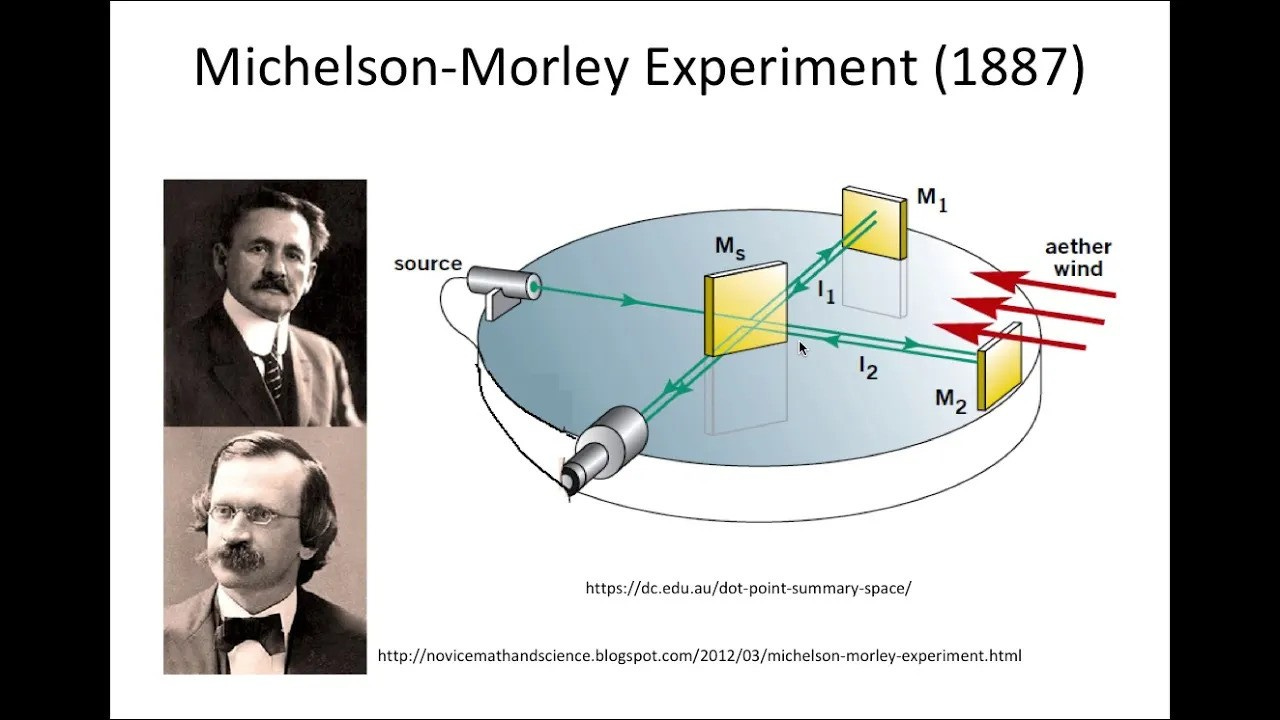
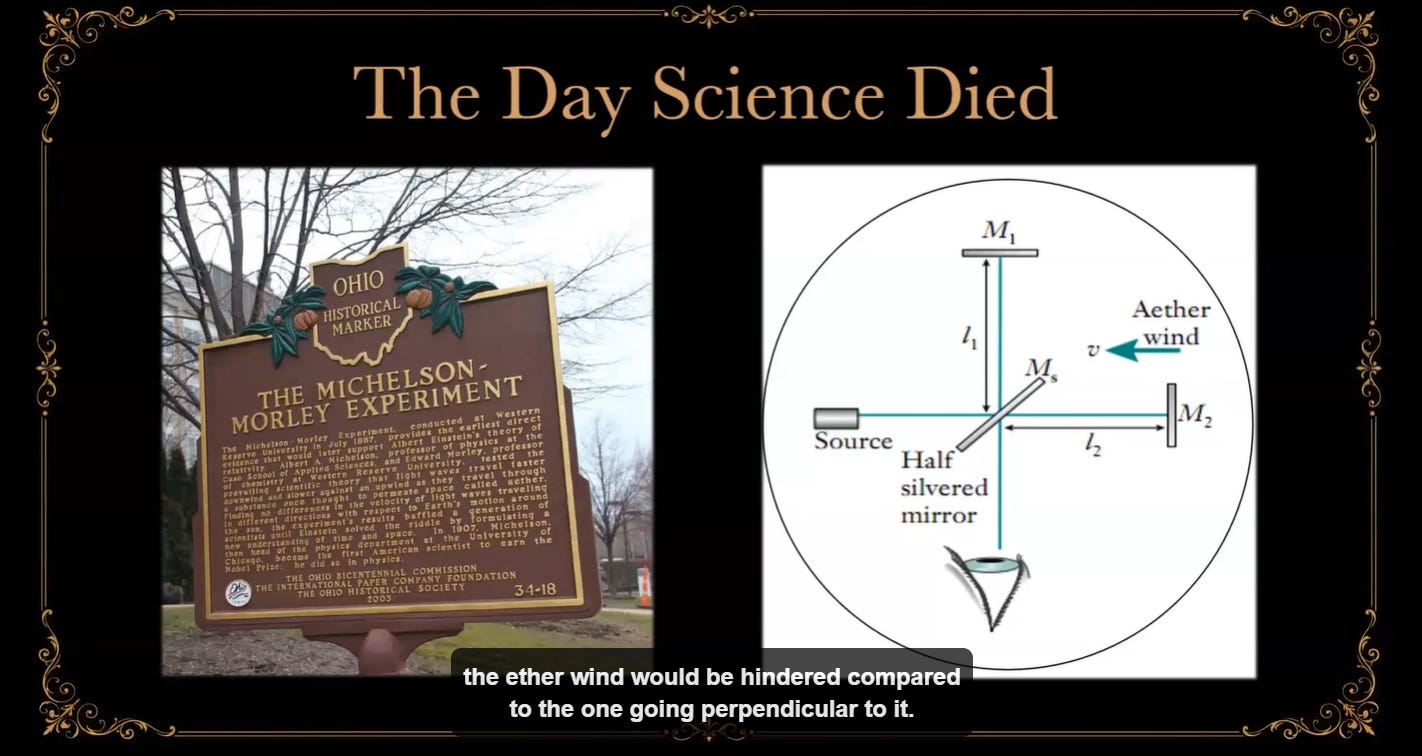
Now, I pinched this from Tom Cowan, but he referred to this as the day that science died. And he was talking about the Michelson-Morley experiment. So the Aether was cast out of modern science based on a single failed experiment known as the Michelson-Morley experiment, 1887. Now they set up this experiment based on heliocentric assumptions. Okay, so they assume the Earth is spinning and rotating and orbiting the Sun and flying through the cosmos. And so they aimed to detect the Aether wind, which was blowing past the Earth as it hurtled through space at astronomical speeds. In the end, they claimed that they detected nothing. And they declared that the Aether is null and void.
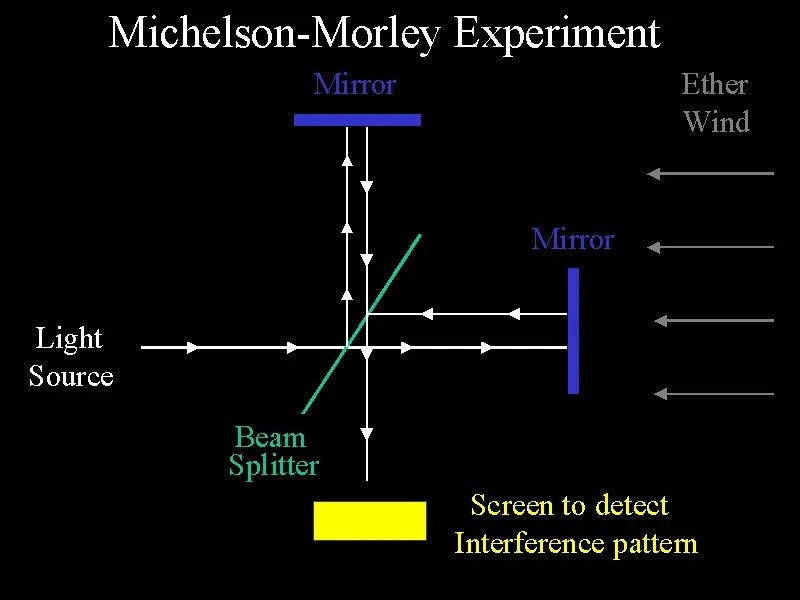
So I’m going to dig into this a bit. Now there’s this marker, this plaque at the Ohio State University where they give a bit of background about it there. Let’s see. They wanted to test the prevailing scientific theory that light waves travel faster downwind and slower against an upwind as they travel through a substance once thought to permeate space called Aether. Finding no difference in the velocity of light waves traveling in different directions with respect to Earth’s motion around the sun, The experiments results baffled a generation of scientists until Einstein solved the riddle by formulating a new understanding of time and space Okay, so this is the crux of it so this is where the Aether was kicked out of science and You can see on the right here is a sort of simple diagram of how the experiment worked so you have a light source and which is heading towards a half silvered mirror and so one of the beams goes up the length L1 up to the mirror at M1 and then comes back down to the observer or the detector which is the eye there and then the other part of the beam that goes straight ahead to M2 and comes back and reflects back to the eye as well.
So the M2 is in the direction of the supposed Aether wind. So if the Earth is flying through the cosmos, then that light beam will be going against the wind that’s blowing along the side of the Earth, whereas the M1 is going perpendicular. And so they reasoned that the light beam going against the Aether wind would be hindered compared to the one going perpendicular to it. And this would cause a slight phase shift when the light recombines at the eye or the detector. And so they expected they would be able to measure this phase shift and thus measure the speed of the Aether wind as it blew past the Earth.
Now this is known as the most famous failed experiment, okay, because it was set up to measure planet Earth’s motion relative to the Aether. They assumed the Earth to be moving at 18.6 miles per second, so about 66,000 miles per hour. But the results that they obtained were actually more than 40 times less than what they expected.
So they dismissed it as being within the range of experimental error. They called it a null result. So they failed to detect the expected motion of the Earth or, vicariously the Aether, and they concluded that the Aether must not exist. But then they continued to assume that the Earth is moving through space, and they brought in Einstein’s theory of special relativity to replace it. Now, most people have heard of the Michelson-Morley experiment, but they’ve probably not heard of Dayton Miller’s Aether drift experiments. Now, there’s a great website that goes into this in detail by James DeMayo. It’s orgonlab.org forward slash miller dot htm and I just brought a quote in from that website there so the history of science records the 1887 Aether drift experiment of Albert Mickelson and Edward Morley as a pivotal turning point where the energetic Aether of space was discarded by mainstream physics Thereafter, the postulate of space was embraced, along with related concepts which demanded constancy in light speed, such as Albert Einstein’s relativity theory.
The now-famous Michelson-Morley experiment is widely cited in nearly every physics textbook for its claimed null or negative results. Less known, however, is the far more significant and detailed work of Dayton Miller. Okay, so Einstein’s theory of relativity demanded that light always appears to go at the same speed regardless of your frame of reference.
So this is why they had to give a null result, a negative result, to be consistent with Einstein’s theory. But they didn’t actually get a null result. And there were other people who did similar experiments and also didn’t get null results. So Dayton Miller actually improved upon Mickelson-Murley’s work in several key ways.
He created a device with much greater sensitivity and a much bigger scale than the Mickelson-Murley device. He performed it at high altitude, like 6,000 feet at Mount Wilson, as well as at sea level. took over 200,000 readings, over 12,000 turns of the interferometer at varying times of day and varying seasons throughout the year over several decades, so maybe about 25 years or so. He also did many rigorous control experiments to eliminate the possibility of error or interference from magnetic fields or temperature changes or air pressure variations, all this kind of thing. He did a lot of control experiments to eliminate all that. And he organized the data by sidereal time.
So he was looking at how the Aether drift was affected relative to the background stars. And he produced consistent positive results across all of this experimentation. Now Einstein said in a letter to Edwin Slauson on the 8th of July 1925, he said, My opinion about Miller’s experiments is the following. Should the positive result be confirmed, then the special theory of relativity and with it the general theory of relativity in its current form would be invalid. And he also said, I believe that I have really found the relationship between gravitation and electricity, assuming that the Miller experiments are based on a fundamental error.
So Miller’s experiments were obviously very threatening to Einstein’s theories of relativity. Now, when we just compare and contrast the Michelson-Morley experiment with the Dayton-Miller experiment, we’ll just look at some of the key differences between them. So the light beam path, for example, on the Michelson-Morley it was a 22-meter path the light was taking around the apparatus, but Dayton-Miller had a much larger apparatus that was a 64-meter round trip. Now the interferometer was quite small in Mickelson-Morley’s, but in Dayton-Miller’s it was large 4.3 meter arms and so on. He also had much greater magnification so was able to resolve the interference fringes with much greater precision than the Mickelson-Morley experiment and he experimented on the top of Mount Wilson about 6,000 feet of elevation as well as on the campus at Cleveland University at near sea level whereas Mickelson-Morley they only experimented one time in a basement of a stone building at the Cleveland University so They were in the basement. Michelson and Morley were in the basement in a stone building. The reason why this might be an issue is that the Aether is said to flow through everything, but it has a harder time flowing through stone and heavy materials like lead and so on than it does flowing through the air or through the water, let’s say. So Dayton Miller, actually in his high-altitude experiments, he just had canvas hanging open to the air so that the Aether was free to flow through the room where the apparatus was and wasn’t being impeded by concrete or stone or anything like that. Now Mickelson-Morley didn’t actually do readings at any different altitudes but Dayton-Morley found that the higher altitude produced a higher speed of Aether flow and that closer to the ground closer to sea level it was a much lower speed and of course under the ground like even slower still Mickelson-Morley only did six hours worth of experimentation over four days in July of 1887 but Dayton-Morley did over 20 years worth of measurements.
The turns of the apparatus: there were like 36 turns in Mickelson-Morley, but over 12,000 turns. Over 200,000 individual readings compared to Mickelson-Morley’s 576 readings. And then in terms of the seasons, well, Mickelson Morley only did this in July of 1887. That was it. Whereas Dayton Miller did it in all seasons over many decades.
So it was a far superior, far more rigorous, far more extensive set of experiments. Now, Miller was increasingly isolated and ignored during his final years. The physics establishment, captivated by Einstein’s theory, simply turned away from him. Before he died in 1941, Miller handed all his interferometer data sheets to his former student, Robert Shankland, with the bitter words, either analyze the data or burn it. Fourteen years after Miller’s death, when no living advocate could defend his work, Shankland published a critique of his work, written in extensive consultation with Einstein. Einstein saw the final draft and wrote a personal letter of appreciation. Shankland and his entire team were Einstein advocates.
No Aether proponents were involved. They cherry-picked the data, resurrected dead criticisms, and misrepresented the work as systematic errors in folly. The very first sentence of their paper repeated the falsehood that Mickelson Morley had a null result, setting the tone for the entire misrepresentation. So Mickelson Morley again they claimed they had a null result but they didn’t actually get a null result it was just much much smaller than they expected based on their heliocentric assumptions but if they were honest they should have reported that they received a non-zero result but this would have upset Einstein’s theory so they reported it as a null result
which was a lie a falsehood and in the very first line of Shanklin’s critique he states this same falsehood again So with Miller dead and Shanklin’s paper published, the erasure of Aether was done. It wasn’t disproven, but it was voted out of physics. Textbooks universally cite Michelson-Morley’s null result as having disproved the Aether, a doubly false claim. It’s doubly false because, one, it wasn’t null, and two, Miller’s work was far superior and showed the opposite of the result. So Mount Wilson itself bears no record of Miller’s decades of work that he did there. There’s now just a memorial plaque dedicated to Mickelson and Einstein.
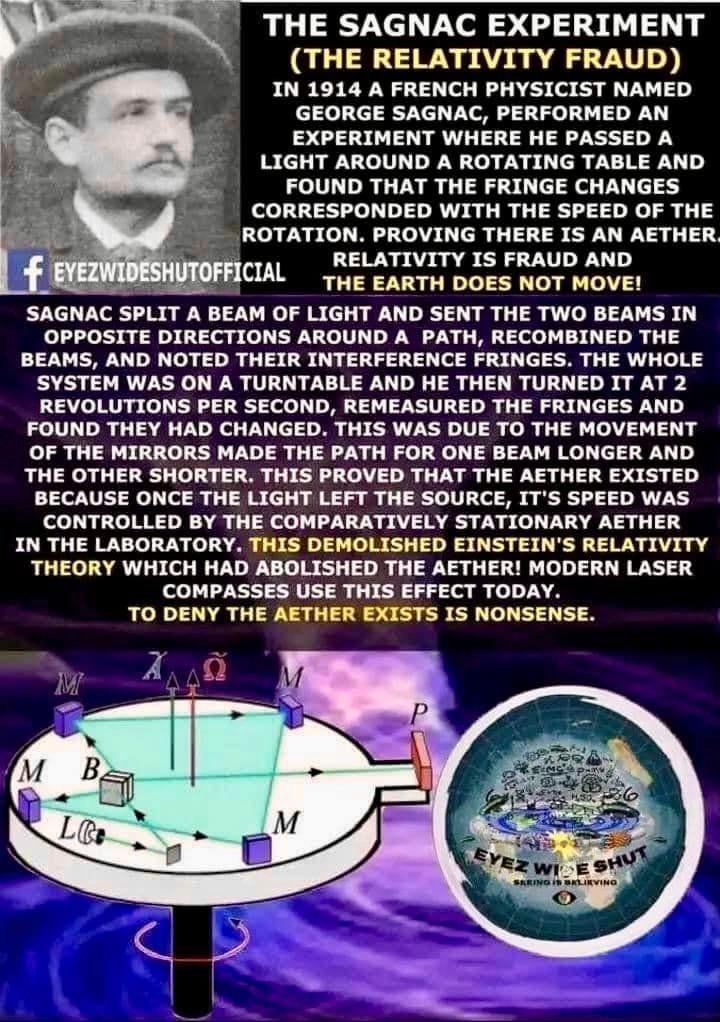
The place where he worked was once known as Aether Rocks, and even that name has been forgotten. And the positive results of Sagnac, Michelson-Gale, Michelson-Pease-Pearson, and Kennedy-Thorndike- which were other sets of experiments that also got positive results for Aether wind, they were all similarly buried or misrepresented as negative results.
So there’s a big conspiracy here to get the Aether out of physics. But before Michelson-Morley, the Aether was not fringe speculation. It was the established, respected, mainstream position of natural philosophy. You have Descartes, who built his entire cosmology on Aetheric vortices. Huygens, which required the Aether for his wave theory of light.
Fresnel developed detailed mathematical models of Aether drag. Maxwell described his electromagnetism as waves in the Aether, perturbations in the Aether. And Lord Kelvin defended the Aether until his death. Faraday’s concept of electromagnetic field lines is essentially an Aetheric theory. Now, René Descartes, in his Le Monde of the World, written around 1632, proposed that space is full. There is no vacuum, no voids. Nature abhors a vacuum. And there’s this thing called the plenum, which is like the substrate, which is filled with subtle matter. All motion is vortical, so everything spins and swirls, and the planets are carried by enormous Aetheric vortices.
Gravity is produced by local vortex motion, pushing things down, and the Earth sits at the center of an Aetheric vortex. Now, the photon fallacy, well, this came about as a result of ditching the Aether out of physics. So going back a bit further, we had this double-slit experiment of Thomas Young, which proved that light is a wave by shining light through two slits and showing that they produce an interference pattern, just like sound waves, just like water waves. Now, so light was proven to be a wave for a long time. But the problem is that waves require a medium of propagation.
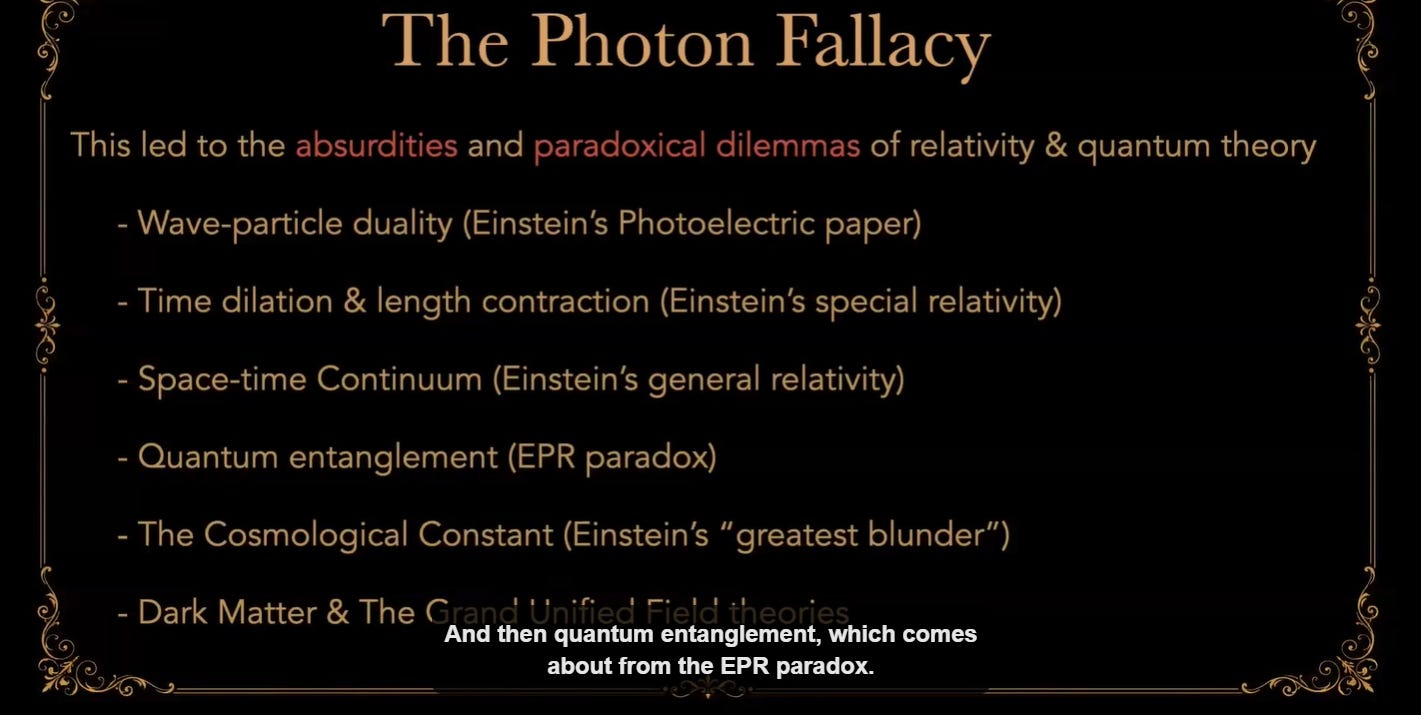
So, in the absence of the Aether, they needed a new explanation for light. And this is how and why the photon was contrived. So the photon is now this hypothetical particle of light, which is said to fly unhindered through the vacuum of space like a speeding bullet. Okay, so rather than a perturbation in the medium, it’s now a thing like a particle of light flying through space. Now this actually led to a lot of the absurdities and the paradoxes and the dilemmas of relativity and quantum theory. So we have things like wave-particle duality, which came out from Einstein’s photoelectric paper, and then things like time dilation and length contraction from Einstein’s special relativity, and then even things like the space-time continuum, which is kind of like a sort of geometric replacement for the Aether. So rather than this kind of fluid substance, it’s represented as this kind of like geometric, you know, trampoline kind of thing, like this fabric, like surface of a trampoline kind of thing. But you’ll notice in the images of the space-time continuum, the way it sort of bends around planets and stuff actually looks a lot like a vortex. It’s the same shape as a vortex. He’s basically taken away the medium, but kept the geometry.
And that’s what the space-time continuum is. And then quantum entanglement, which comes about from the EPR paradox. That’s called the Einstein-Podolsky-Rosen paradox. So Einstein again. And this led to the idea of quantum entanglement. Again, this all just comes out from the photon fallacy. And the cosmological constant, which was a thing that Einstein came up with that he later referred to as his greatest blunder. Things such as dark matter and the unified field theories and all this kind of stuff all come out from this fallacy of the photon. There’s no such thing as photons. Light is a perturbation in the Aether.
It’s not a particle flying through the vacuum of space. But because physics ran with that, they’ve had to come up with all this new stuff to kind of explain it. And they’re always kind of like reaching for the Aether, it seems, because it’s very hard for them to explain anything without it.
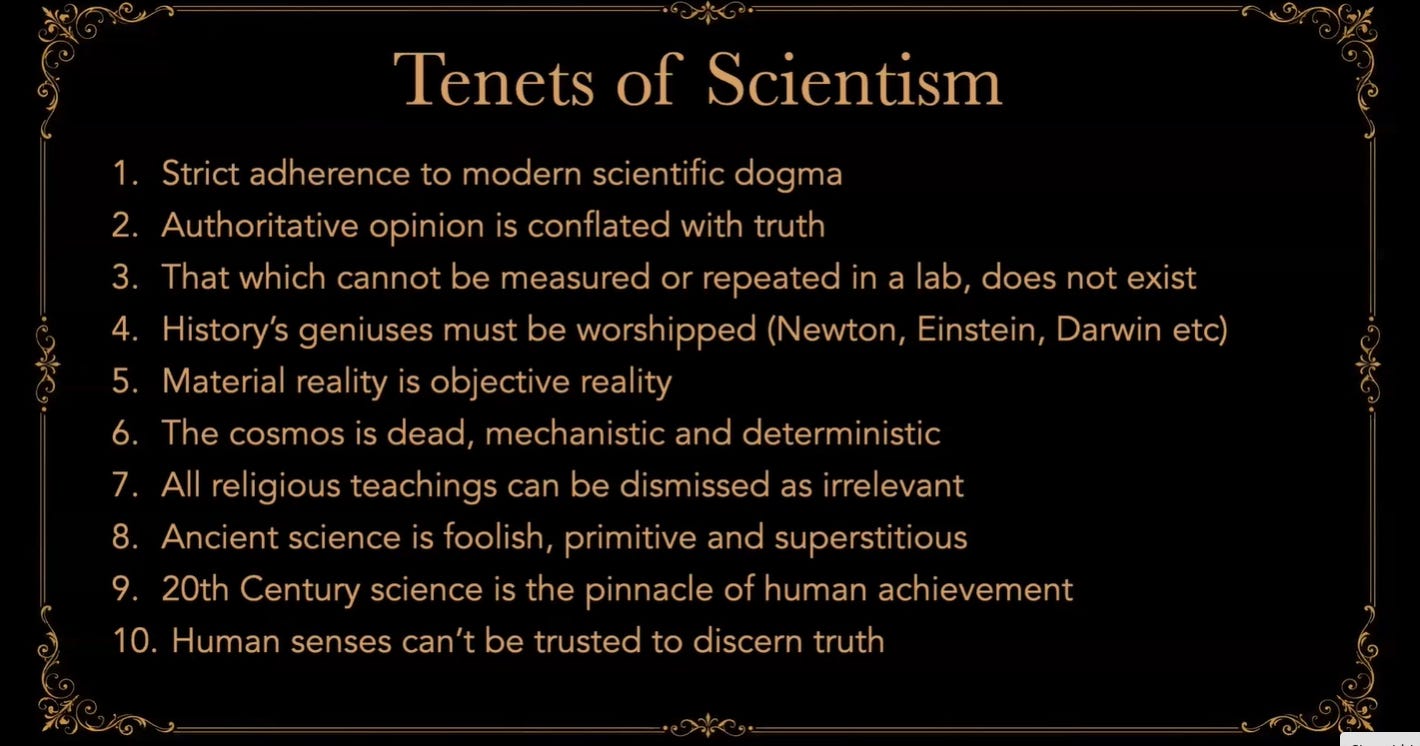
So a stationary Earth embedded in the luminiferous Aether was theologically and philosophically intolerable to the materialist architects of the modern age. The photon was the bandage applied to the wound they inflicted when they killed the quintessence. And Einstein, which means one stone, was the cornerstone upon which the entire edifice of scientism was constructed, the instrument by which the true science of alchemy was buried and forgotten. So talking about scientism then, the literal belief in scientific theories, specifically modern scientific theories. Now, some of the tenets of scientism are, well, of course, strict adherence to modern scientific dogma. Authoritative opinion is conflated with truth, you know, so the opinions of authorities such as Einstein will just be conflated with truth and considered to be unquestionable. And things that cannot be measured or repeated in a lab basically don’t exist, are not worthy of consideration. Now, history’s geniuses such as Newton, Einstein, and Darwin are all that must be worshipped and never questioned.
Material reality is considered to be objective reality, so anything immaterial is essentially not real, not worth consideration. The cosmos is itself a dead, mechanistic, and deterministic entity, like a kind of clockwork thing. And all religious teachings can be dismissed as irrelevant. Ancient science is considered to be foolish, primitive, and superstitious, which is how they view the Aether and alchemy. And 20th-century science is the pinnacle of human achievement. And finally, the human senses cannot be trusted to discern truth. You don’t have to have a PhD in science to be indoctrinated with this stuff. It’s built in throughout school, all levels of school programming as well as media and science fiction and everything. We’re just constantly being indoctrinated with these kinds of tenets and kind of forced to accept these experts as the kind of priests of scientism. Now, when we compare and contrast Alchemy with Scientism, we can look at the ways in which they differ.
So the first principle of alchemy in the Seven Hermetic Principles is that all is mind. This is the idea that the Aether, or the all, the medium in which we’re all a part of, is actually mental. It’s a type of mind. So the mind doesn’t come about from the flesh, but the mind is like an intrinsic part of the cosmos. But in scientism, the first principle is that all is matter. Everything is just matter, floating about in a void, in nothingness. In alchemy, the source of truth comes from divine revelation, but also direct observation. Whereas in scientism, the source of truth is theory and institutional consensus.
Matter, in alchemy, is viewed as consisting of the four elements and the three principles. Whereas in scientism, matter is said to consist of atoms, molecules, and forces. Now the cosmos itself, in alchemy, is said to be a living thing. It’s ensouled, and it has a soul, but also stationary and enclosed.
Whereas in scientism, well, the cosmos is dead. It’s a mechanical thing. It’s spinning, and of course it’s exposed. It’s completely open to the big wide cosmos. Open to all the influences of the infinite universe. Consciousness in alchemy is the ground of all being. As we said, like with the all is mind.
But in scientism, consciousness is considered to be an epiphenomenon of the brain. Or another way I heard it described was a secretion of meat. So I guess like just some kind of fluid that is produced by the matter in the brain or something. Now, man in alchemy is viewed as a microcosm of the macrocosm.
So a miniature universe, essentially. And the universe being structured like a giant man. But in scientism, well, we’re an evolved ape or a biochemical machine. Now in alchemy, the goal of the work is collaboration with nature, to be nature’s greatest collaborator, but also inner transformation.
So transmuting your own inner lead into gold and bringing yourself closer to God and so on. But in scientism, the goal of the work is power over nature or technological dominion, and we’re seeing that now with all this crazy technology and surveillance systems being rolled out all over the realm.
So the view of health in alchemy is that the body must be purified. In scientism, it’s that the disease must be killed because the disease is treated like a material thing, a material object or a material creature, and that must be killed using drugs and surgery and radiation. Whereas in alchemy, the body is trusted as an innate Healing capacity, and so really for healing we must purify the body to enable it to do its thing. So transmutation is the essence of all good works, turning something into something better, but in scientism it’s considered to be physically impossible or too costly to be worth doing. And then finally, the Aether.
Well, in alchemy it’s the omnipresent fluid medium, the river of life, but in scientism it’s a primitive, archaic concept and does not exist because it got disproved by the Michelson-Morley experiment. So we can see how science as a whole has just changed radically by abolishing the Aether. As Tom Cowan said, it’s the day that science died.
Now I’m going to look at some of the quotes from some famous alchemists. So Hermes Trismegistus. I don’t know if he was a real living man walking the Earth or not. But what I do know is that he is the most frequently cited name and reference in all of the alchemical literature.
And he’s considered to be the kind of patron saint of alchemy. And so in the Corpus Hermeticum he says, the cosmos is filled with the divine mind, and there is no void in all of nature. What men call space is in truth full of spirit, full of invisible bodies, full of the breath of God. Paracelsus, he said, there is a star in man, an invisible fire, a celestial influence which is not perceived by the senses, but which acts upon the body and the soul. This is the astral light, the universal agent, the living fire of the philosophers. He also said the Iliaster. The iliaster is a good word.
Is the first matter of all things. It is the invisible and intangible substance from which all visible things are born. It fills all space and penetrates all bodies. Without it, nothing could exist. So Isaac Newton, even though his theory of gravity was kind of used as part of the anti-Aether apparatus, was himself a believer in the Aether. And he said that perhaps the whole so this is the idea that the spiritual vapors of the Aether kind of condense into thicker and thicker forms, and that’s how the elements come about and how the gross matter comes from subtle matter. My good man, Robert Flood said, The Aethereal heaven is the universal medium through which all celestial influences descend into the sublunary world. It is the bond between the creator and the creation, the vehicle of sympathy and antipathy, the ocean in which all worlds swim. So I like here that he’s linked Aether with the heaven, the Aethereal heaven.
Sometimes the Aether is referred to as heavenly air or the breath of God. And also it’s the bond between the creator and the creation. Again, there’s that bridge again. I’m talking about Aether being the bridge between science and spirituality, but also, in a way, the bridge between man and God or the creator and the creation.
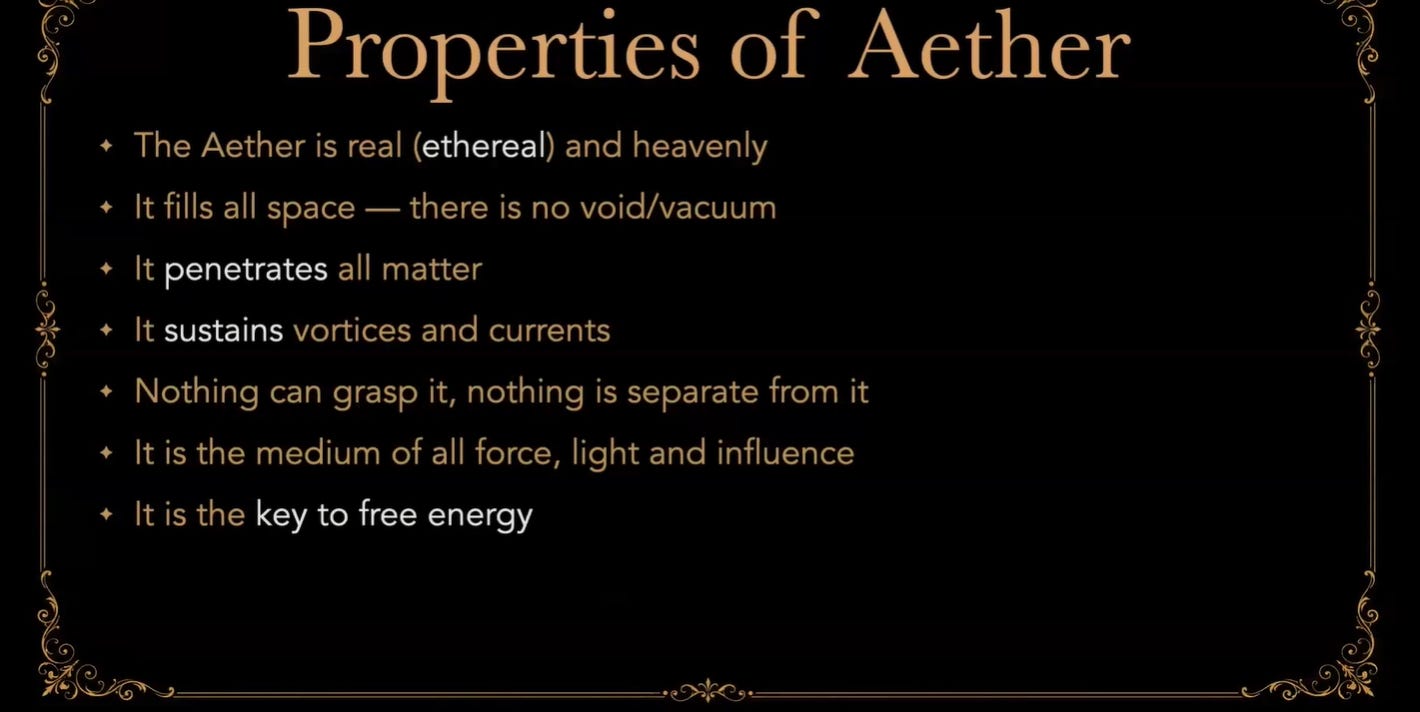
Alchemist Jacob Bohm said, Listening to all that, we can list what some of the properties of this Aether might be. So we can say the Aether is real, and this is where we get the word Aethereal from, which is a fusion of Aether and real to help us remember that the Aether is real, and also heavenly in nature. It fills all space, so there are no voids, no vacuums. And it penetrates all matter. So this means nothing can grasp it or nothing is also separate from it. It can’t be contained. It’s able to sustain vortices and currents like any fluid. It’s the medium of all force, light, and influence is the key to free energy. Now, I don’t go into this too deeply in this presentation because I think it will be worth doing another presentation in the future looking specifically at this issue. But the reason it’s a key to free energy is that all energy and electricity comes from motion.
And the Aether is in constant motion around the Earth. And so this is how these old world buildings, the spires on churches and things, can tap into the Aether because as you go higher and higher up, you get a greater voltage. I think it’s about 100 volts per meter you get as you increase height.
And so by having a wire high up in the sky and then attaching it to coils and various other Devices, you can start to draw energy out of the Aether and build it and store it and so on. So Aether is really the key to free energy.
And, you know, they don’t want- I say they, I mean, whoever changed the world after World War I. Everything got changed: medicine, physics, all of it, the world history, everything really changed after World War I. And it seems like they don’t want us having free energy because if energy was free, then basically there’d be no need for labor. And they need labor to control us. I think it’s a lot to do with that. But anyway, I’ll go into that in a future presentation. So the elements condense from the Aether by inspissation. This is my new favorite word.
I just found it in an old alchemy book called The Golden Chain of Homer. I’d never heard this word before, but it means thickening. So if you think about it, we’ve got the Aether, which is the thinnest fluid, and then it’s permeated with a kind of cold light like the astral light, and the persistent action of that light in the Aether causes it to thicken, and it thickens into air. And then the air then thickens into water, and then the water then thickens into Earth. Okay, that’s what inspissation means. It’s the thickening of the Aether from subtle states into more gross states. And Aether is conscious.
It’s not just a dead mechanism, but it’s the living spirit itself. Now, you can have stable vortices in fluids, particularly as they become thinner. So things like these dolphin bubbles, which look like it’s just a ring floating in the water, but actually it’s a vortex. And you can see this; there are some videos of people. They’ll crack an egg inside of a dolphin bubble, and then the egg starts spinning around the outside of it. There’s an actual torus field inside of those dolphin bubbles, and they can be created, obviously, with smoke rings as well. You see people doing the smoke rings with vapes where they’ll blow a smoke ring, and then they’ll blow another ring inside of the one that they’ve just blown, and then it starts to spin around in a toroidal vortex flow. So yeah, you can create a stable vortex in a fluid, but it depends on the thickness or the thinness of the fluid, like how long it can last.
So actually there’s a theory in fluid dynamics which says that the viscosity of a fluid is inversely proportional to the lifespan of the vortex. So what that means is the thinner the fluid, the longer the vortex can be sustained. So in theory then, a fluid with an ultra-low viscosity could sustain vortices indefinitely.
Again, going back to the sort of thickening, if you think of a really thick substance like treacle or crude oil or something like that, and you try to get a vortex going, it’s not going to last very long. But then you take a thinner fluid like water, and then you try to get a vortex going, and yeah, you can keep it going for quite a while. But then go for a thinner fluid again. Look at air, for example. Well, you can get vortices sustained for a lot longer in air than you can in water. We see this in like tornadoes and hurricanes and so on. They can be sustained for like several hours.
So if we go to a fluid of infinitely low viscosity, which is what the Aether is said to be, then in principle it can sustain vortices indefinitely. Now there was actually something called the vortex theory of the atom by Lord Kelvin, and in this it was postulated that matter is composed of knotted vortices in the Aether.
So this is an image of that theory on the right there. And the idea is that the vortices can form knots, and so the different substances of matter are actually, they get their qualities from different types of vortex knots that are happening in the Aether.
So again, this is the idea that the substance matter comes from Aether, not from atoms. So the Aether and the atom are kind of diametrically opposing theories. The Aether is natural, qualitative, living, and spiritual. It posits that space is filled with an omnipresent fluid substance and that matter is infinitely divisible.
In principle, you can just divide it up and divide it up again. It’s like a fractal. And all substances are different forms of Aether, and the fundamental elements are fire, air, water, and Earth. Whereas in the atomic theory, in quantum theory, which was propped up in place of the Aether, is a synthetic, quantitative, dead material thing.
Space is said to be an empty void populated with infinitesimal particles just floating around and bumping off each other. And matter is ultimately indivisible or atomic, so when you divide it down you eventually get to something that you cannot divide anymore and that’s just the end of it.
And then substances are said to be different combinations of atoms. And then of course the fundamental elements are said to be hydrogen, helium, lithium, and beryllium and so on. So these are completely different worldviews that are being expressed through the Aether and the atomic theory. Now you’ve seen the symbols before. I’ve talked about them: fire and air being the upward triangles and the water and the Earth being the downward triangles because of their direction of flow. And then when you add those four symbols together, you get the symbol for the Aether, which is the six-pointed star. And again,
I know this is on the Israel flag and is a symbol of political Zionism and so on, but that is a new use for it. I don’t know exactly why it’s on the Israel flag, but it’s an ancient scientific symbol, and it can be found in very old books, and it’s actually a very profound symbol, and it’s not an evil symbol. There’s nothing evil about it. It’s actually very beautiful and expresses how the Aether manifests into reality. I’ll come to that in a little bit. I concluded a few years ago that the atom is actually a type of idol.
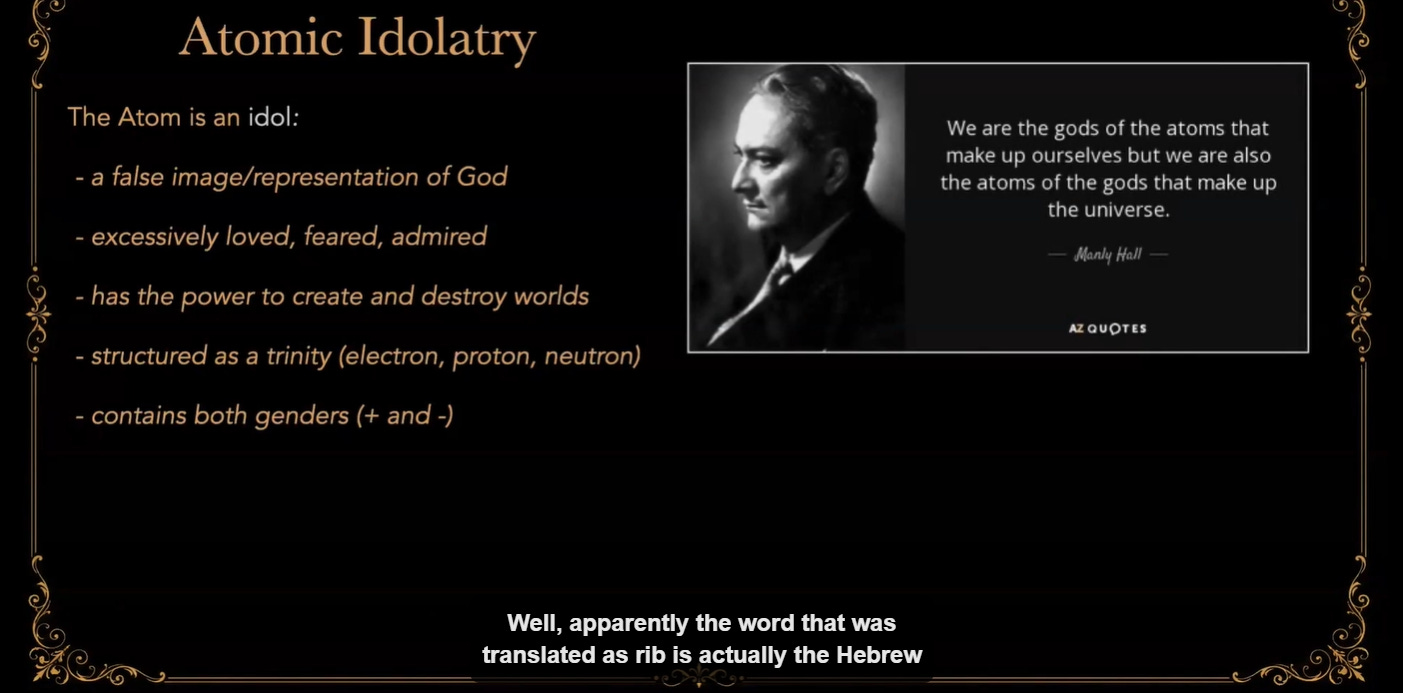
So I like this quote from Manly P. Hall where he said, we are the gods of the atoms that make up ourselves, but we’re also the atoms of the gods that make up the universe. I think there’s truth in this statement, and that because the word God is synonymous with creator.
And so he’s saying we are the creators of the atoms. We are the creators of the atoms. That’s true. We made up atoms. It’s a man-made synthetic thing. But we’re also the atoms of the gods. And here the word atom can be switched for Adam. It’s like we are the atoms of the gods.
Because God made Adam, the human being. And that’s what we are. We’re like the atoms of the gods or the atom of God. So the atom is an idol in that it’s a false image or a false representation of God. It is something that’s excessively loved, feared, and admired, which is a sign of an idol.
It has the power to create and destroy worlds. I’ve talked about this before but the atom is said to have created the universe because the universe produced atoms in the Big Bang and then those atoms through their own just random interactions gave rise to molecules and organisms and all kinds of materials and to human life and everything that we now know and love so the atom has the power to create worlds but also via the atom bomb is said to have the power to destroy worlds. So that’s a divine power which is being attributed to the atom.
It’s structured as a trinity: the electron, proton, and neutron. And, of course, in all the mystery traditions and spiritual literature, God is also structured as a trinity and depicted as a trinity in various ways, such as the Father, Son, Holy Spirit, and so on. It contains both genders, both positive and negative, which is masculine and feminine.
Interestingly, I learned something the other day. It says in Genesis that Eve was created from Adam’s rib. Well, apparently the word that was translated as rib is actually the Hebrew word that was translated to rib is actually found elsewhere in the Bible and is translated as side.
So this is the idea that Eve was created from one side of Adam. Not necessarily like the rib. And I quite like this because in the alchemical tradition, God would be considered as having two sides: having a masculine side and a feminine side. So it kind of makes sense then that when Adam
When Adam was made into Adam and Eve, it was one side of the divine was made into Eve and the other side to Adam, and this was the separation of genders. Okay, so the atom also hides the Aether. As I say, it’s kind of put there in place of it,
but it also hides transmutation, like in the periodic table. They tell you you can’t change one type of substance into another because they’re made from specific types of atoms, and it’s not easy to change one type of atom to another. It’s too hard, too difficult to be worth doing. So the whole thing is completely antithetical to alchemy.
And it’s also used by the government to scare you. Now, the atom, the symbol for the atom, is more or less identical to the symbol for the Aether. It’s basically a six-pointed star, although they’ve made it a bit more kind of rounded and curvy with the dot of the nucleus in the middle there.
But when you overlay them, you can see it’s basically the same symbol. It’s just been tweaked. As I say, it’s not an evil symbol. It is a very meaningful scientific symbol for the Aether. So Paracelsus called it the Iliaster, which the word Iliaster breaks down to ili, which is from hyla, like H-Y-L-E, meaning matter.
And then aster means star. So it’s like a matter star or a star of matter. He said there’s a star in man. And you know one of the ways we see this in nature is of course in snowflakes, which are all individual and unique but always have the six-pointed star formation.
And it’s quite a good example because, going back to this word in specific, this is what we’re seeing with snowflake formation. We have something which is subtle, as in the water vapor in the air, and then it’s thickening into snow. And in that thickening process, it adopts the structure of the six-pointed star, but it does it in a fractal way, such that every snowflake is unique, a fractal representation of this IIiaster. And of course we see it in many different flowers as well, and I was actually talking with Adam Bigelson, who does a lot of this holographic blood work like microscopic analysis of blood and he said he’s even found these six-pointed stars in the blood under the microscope, so it’s something that actually occurs in nature it’s not just an evil symbol I got this from Marty Leeds, who did a brilliant presentation on Aether a few weeks ago and of course pointed out that the internet is actually called the Aethernet.
The Aethernet is the name for the cables that link the computers together that actually create the network and the cables are of course a medium that connects things so it’s kind of appropriate that we’d be named after the Aether which is the medium that connects everything. And then there’s this cryptocurrency, Aethereum, which is interesting.
Again, if you look at the symbol for Aethereum, they’ve not used the six-pointed star, but they have used the two triangles. It’s got the upward triangle and the downward triangle. And of course, what is Aethereum? Well, it’s a medium of exchange. So I really think they know about this,
they know about the Aether at the kind of high level of technological industry and so on. But for some reason they just don’t want us knowing about it. So what about names of the Aether then? So I’ve been calling it the Aether all this time and using this particular spelling\ of it with the A in front, and I’ll address that in a little bit. So you’ve got the luminiferous Aether, Aether with an A or without the A. And luminiferous, it kind of means to shine. It’s like this kind of shining, the kind of gleaming medium of creation.
You’ve got the quintessence, or the fifth essence, beyond fire, air, Earth, and water. The prima materia, or the first matter from which all things are condensed. The spiritus mundi, or the spirit of the world, or the anima mundi, which is like the soul of the world. The astral light, as Paracelsus used it, and later Eliphas Levi.
Another Paracelsus term was the mysterium magnum, the great mystery. The IIiaster, as well as the term for the prime substance. The waters above, so from this idea that the waters above and the waters below. So we have the liquid waters below and the Aetheric waters above, or the medium above the firmament.
And even the Holy Ghost or the Holy Spirit or the breath of God. Because you have in the Trinity, of course, the Father, the Son, the Holy Spirit. Well, the Holy Spirit is the medium, the medium between the Father and the Son. We have things like the azoth, which was like the universal solvent and medicine of the alchemists. The philosophical mercury, so not quicksilver, not the metal, but the subtle living spirit in all things. The universal agent, which is like the active medium of all transformation. The secret fire. The universal menstruum, or the solvent that’s able to dissolve and renew all things. The alkahest, which again is another idea of the solvent and closely related to the Aether concept. The virgin’s milk, which is an allegorical name for the purified quintessence. So this is what they would get from the rain or the dew, the celestial dew. So as the rain comes down, or particularly the dew, they would
They would gather this and then, through working it alchemically, they were able to get a salt or a substance out of this which they called the virgin’s milk or the celestial dew. And then things like the akasha, the all-pervading space substance, the fifth element. Prana, the vital breath or the life force.
Prakriti, the primordial nature or the undifferentiated substance. Qi or Ki, the vital force from the Chinese and Japanese traditions. Ein Sof Ur from the Hebrew, the limitless light or the infinite radiance preceding creation. Ruach, the breath of the spirit or the wind of God. Orgon, as in Orgonite, Wilhelm Reich’s term for the life force energy.
Mana, which is a Polynesian vital force pervading all things. And Manitou, which is the Algonquin great spirit pervading creation. Manitou is also a brand of organic tobacco that I’ve smoked on some occasions. I was quite pleased to find out that the tobacco I’d smoked was actually named after the Aether. Debris. Okay, so as I said, in physics, they’ve been kind of, because they threw out the Aether, they’ve been kind of bringing it back under various names. So things like the vacuum state, the seething energetic emptiness of space, or the zero point field, this irreducible energy of, quote, space. The Higgs field, which is the omnipresent field that gives mass to matter.
That’s like the inspissation again. Dark matter or dark energy. Well, invisible, undetectable substance pervading the cosmos, penetrating all things. Again, it’s just Aether. The space-time continuum. As I talked about before, the space-time continuum is just the geometry of the Aether. They’ve abstracted the geometry from the medium itself, and then they talk about the geometry as if it’s this kind of independently existing thing that exists without a medium. So space-time continuum is very abstract. The unified field. Okay, so this sought-after singular medium underlying all forces. The inflation field. So this was a new one on me, but this is, I guess, a new physics theory of this hypothetical field that’s driving the cosmic expansion. So similar to dark matter and dark energy. Quantum foam. The turbulent substrate at the smallest scale of reality. So when they say smallest scale, they mean in between the atoms. So in between the atoms, like space, right? Or Aether.
And then the superfluid vacuum. So this is the idea that space itself is a kind of superfluid. I thought it was interesting to run with that because actually Einstein said in his 1905 paper that the introduction of a luminiferous Aether will prove to be superfluous. Now, the word superfluous is actually defined as unnecessary.
But interestingly, it sounds just like superfluid. And what are the properties of a superfluid? Well, a superfluid has zero viscosity, so it flows without resistance, without friction. It has perfect coherence, so it behaves as one unified substance. It sustains vortices indefinitely and pervades everything. It moves through matter and cannot be contained.
And it supports vibration that pass through it with perfect fidelity. So the Aether is a superfluid. Now, 15 years after that quote, Einstein is also quoted as saying, according to the general theory of relativity, space without Aether is unthinkable. So space without Aether is unthinkable, and he said that 15 years after he said that it was superfluous.
Now, just looking at the word Aether the word so it’s a it’s a beautiful word you may have seen before. It makes all kinds of beautiful anagrams such as an anagram of Earth and heart and hearth, which I quite like, particularly those because we have this association with like homeliness okay so we got the Earth is not only the element Earth but Earth is also the name for our home right the place where we live And then we have our heart which is like kind of like the center of our being and also it said like home is where the heart is.
But then also hearth, which is basically like the fireplace or the kitchen, you could say, which you know every home has to have a hearth. Like home is where the hearth is. But it’s also an anagram of things like heater, where obviously heat comes from, or reheat. The ear, which is quite a nice one.
The ear, but also the air. And I know that’s not how we spell air now, but that was the original Latin spelling of it in all the old alchemical artworks and so on. The air is spelt with an E. So it’s an anagram of the ear and the air.
But then if we look at, like, near anagrams, so closely related words, we find that it’s an anagram of three, so if we drop the a from it we get three or there here or like hater or threat weather of course, the weather is the Aether feather which feather of course moves the Aether leather theater
The world is a stage, right? The world is a theater; the world is the Aether. Breathe, father, and then there are related things like either, you know, either or, other, or neither, or Aether, which is, you know, if Aether is above, Aether is below. Or Aether, which is,
again, is like a medium that holds things together, that joins things together. So it is a beautiful word, and there’s actually one I didn’t put in there I learned recently is a Welsh word, hirath, which is h-i-r-a-e-t-h, and that’s also an anagram of Aether, and it means a sense of belonging.
So I do feel there’s something about the Aether. It’s really our home. It’s where we come from. It’s where our consciousness and awareness come from. We’re embedded within it. Yeah, it powers our heartbeat, our breath. So you can see that by kicking this out of science, they’ve really severed our connection to our home.
And so it’s no wonder the human race is so lost. So, is it Aether with an A or Aether without an A? Well, a few weeks ago, Marty Leeds of the Gnostic Academy. Shout out to Marty for just being absolutely on fire with great content every single week.
He did one called Aether Physics and the Book of Genesis. And he pointed out that the A-E, the symbol A-E, which is used in the word Aether, is actually not a part of modern English. It was used in Old English for words of Latin or Greek origin, but now technically it’s just replaced with E. Now, the reason why this matters is that the English language is actually encoded with a numerical cipher called the septenary cipher. And Marty Leeds has shown this, has proven this again and again and again in a multitude of ways that this is the true cipher of the English alphabet in the science of Gematria.
So the septenary cipher basically it just assigns numbers to the letters going up as far as 7 so g equals 7 and then it starts going back down again h is 6 i is 5 j is 4 k is 3 2 1 and then so m is 1 and then starting again on 1, n is 1, o is 2, p, q, r, s up to t equals 7 and then it goes back down again to 1 with z being 1. Now he’s showing that with this cipher you can find all kinds of beautiful and meaningful geometric numerological connections within the English language and in the Bible, and for me, it just makes it all so divine in nature. It’s actually hard for me to imagine that any human being could have come up with this stuff. There are so many levels of meaning that open up once you start looking at the geometry of the English language using the true septenary cipher.
There are many other ciphers that people use. But I would say that the actual true one, the one that the language was made with, is the septenary cipher. And Marty’s done a great job of proving that in hundreds of videos and many, many books as well.
So when we look at Aether, then without the A using the modern English spelling, we get 57655, which totals to the number 28. Now 28 is a perfect number, right? And this is from mathematics. A perfect number is defined as a number which is equal to the sum of its proper divisors.
So 28 is equal to 14 plus 7 plus 4 plus 2 plus 1. So that’s all the proper divisors of the number. When you add them together, you get the number. Now this is actually very, very, very rare. There are only 52 perfect numbers that have been discovered in all of mathematics.
And this is even using supercomputers to test numbers with billions of digits. There are only 52 perfect numbers, one for every week of the year, that have ever been discovered by mathematics. So I thought, That’s interesting, and we see this in the human body as well.
Now, Marty often talks about this, but our hands and feet are encoded with the number 28. So on our fingers, we have 12 phalanges on our forefingers and then 2 phalanges on our thumb. So there are 14 on the right hand and 14 on the left hand. That’s 28.
And the same is also true on our toes as well. But there are also 28 bones in the foot. And 28 bones in the skull And we also have 28 days of lunar light each month Now, I know a lot of people say that the lunar cycle is 28 days But it’s actually 28 days
of light And then there’s an extra day and a half of lunar darkness, the new moon So the total length of the cycle is about 29 and a half days But we have this 28 days of lunar light every month So this number is written into the essential design of our body and also the design of the cosmos. And interestingly, if you separate the consonants from the vowels, you get 18 and 10, which when you multiply them together is 180, which is the total degrees of the inside of a triangle. Again, this is meaningful because, as we said, God is expressed as a trinity, which is a triangle, and Aether is an anagram of the word three, which is the number of the trinity, and a triangle is a geometric expression of the number three. But not only that, the numbers 0, 1, 2, 3, 4, 5, 6, 7, 8,
9, which are known as the 10 emanations of God in the Kabbalah, also total to 180. So we see this beautiful correspondence between the language and the geometry. And it’s just too much to have been a coincidence. Actually, Marty found that if you take the numbers 1 to 10, so dismissing the zero and just going 1, 2, 3, 4, 5, 6, 7, 8, 9, 10, that also sums to 180. So, we are the Aether. And I’ve switched to the modern English spelling now. So I’ve been using the AE all throughout this and through my book and everything. But I feel like I’m going to have to adjust it now to make it the proper English spelling with the proper numerology and geometry. So we are the Aether, and we experience the elements. Now in this artwork here you see from Michael Meyer from 1617 you’ll see there’s a guy on the right with a club and he’s battling against four other guys there but if you look and you see their face they’re all the same guy they all look the same they got the same beard the same hair they’re the same height now the guy at the front he’s got fire in his hands And the second guy is shooting air out of his hands.
Then the third guy is shooting water out of his hands. And then the fourth guy has a big lump of Earth that he’s throwing at him. Okay, so this represents the Aether battling against the four elements. Which are four different forms of itself, and these are called the elemental ordeals so this is about the different types of ordeals and battles that we face in life so in an ordeal of fire which is said to test our willpower and our character this would be things like trial by fire so verbal attacks taking heat or hate which of course is an anagram of heat just like hater and heater are anagrams of Aether. But yeah, when you’re taking hate, you’re getting slandered, persecuted, bullied, abused, harassed, scorned. These are like kind of tests of character. This is considered to be an ordeal of fire. With the Earth element, then, so this is about the body, so obstructions, blockages, physical resistance, injuries, being stuck between a rock and a hard place. I think that’s a good sort of metaphor for an ordeal of Earth. When you have obstacles to overcome, and it tests your adaptability. Those would be ordeals of Earth and then you have ordeals of air
which are mental this is more like loss of control or loss of things that we depend upon and this kind of tests our attachment to our beliefs our attachment to people and material objects and so on And then with water ordeals, well, this is emotional and this is kind of like a sink or swim is a good metaphor there. Like rapidly changing circumstances, community issues, things that test our altruism and our empathy and ability to come together and help other people in a crisis. So yeah, this is quite interesting. So next time you’re facing an ordeal in your life, have a think about what kind of an ordeal it is, and you can have some idea of how to get around it. The element of water will help you overcome fiery ordeals. The element of air will help you overcome Earth ordeals and so on.
So you can look at the opposite element to the one that you’re facing, and that can help you to get through it. Quite interesting. I wrote this little Aether invocation. So these are just like little poems or little statements that just kind of like help us to, you know, connect with and sort of appreciate the Aether.
So it goes like this. Hidden ocean, omnipresent and unseen. You who fills all space, whom the blind have denied. Cast out from their equations, yet sustaining their every breath. Return to my knowing, O carrier of prayers, the medium of light, the source of creation, the silent witness of all.
Okay, and just to finish up then, now this is an art piece I did with AI, and yes I know it’s AI, but I had the vision, and I wrote the prompt and everything, and I would like to actually paint this one day because I think this really nicely captures the idea of the Aether conspiracy.
So we see up at the top of the image, we see the sun and the swirling vortex of the Aether around it and various alchemical symbols representing the true science, the higher knowledge of the sun and the cosmos. and then we see below we see the academics with their square hats and their black robes and they’re pulling a veil in front of all that a veil loaded with equations relativity equations quantum physics equations and so on that’s the veil that they’re using to hide the alchemical knowledge and then we see down the bottom There’s the common people, they’re all reaching up, reaching up to the veil. You see, they want the true knowledge, they want the higher knowledge, but what they’re given is this veil of complex theory that keeps them in the dark. So as I say, I know it’s just an AI sketch, but I would really like to paint a version of this myself one day. Alright, thanks for listening, everyone. Yep, that’s all for today.”
Steven is a legend. Who doesn't love listening to an astophysicist debunk physics in a Scottish accent?